
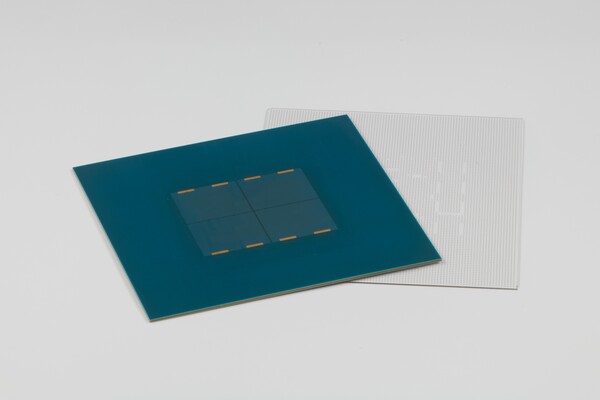
Competition over glass substrates, a next-generation semiconductor packaging material, is shifting from individual company technology validation to a race to build supply chains among materials alliances. Samsung Electro-Mechanics is moving to establish a 480 billion won joint venture with a Sumitomo Chemical group affiliate, sharpening its rivalry with SKC, which has secured its first mass-production plant in the United States.
Samsung Electro-Mechanics on July 2 signed a definitive agreement with Dongwoo Fine-Chem, a wholly owned unit of Sumitomo Chemical Group, to establish a joint venture, tentatively named Glassem, to produce the key glass substrate material known as a glass core. Total investment is 480 billion won, with Samsung Electro-Mechanics contributing 66 percent and Dongwoo Fine-Chem 34 percent. A filing shows Samsung Electro-Mechanics will acquire 63.82 million shares in Glassem for 319.1 billion won, with the expected acquisition date set for Sept. 1. The headquarters and production base will be built at Dongwoo Fine-Chem's site in Pyeongtaek, Gyeonggi Province, with a target start of operations in the second half of 2027.
Glassem is structured to internalise glass core production by combining Samsung Electro-Mechanics' substrate design and manufacturing capabilities with Sumitomo's materials technology and Dongwoo Fine-Chem's production infrastructure. Samsung Electro-Mechanics is reported to be aiming to enter the supply chains of big tech companies such as Apple and Broadcom. Samsung Electro-Mechanics Chief Executive Jang Deok-hyeon (장덕현) said it was a strategic choice to preemptively secure core competitiveness in glass cores and that it would maximise synergy between the two sides to lead a paradigm shift in the next-generation semiconductor substrate market.
Samsung Electro-Mechanics is targeting SKC, which entered the market earlier. SKC had already been increasing funding before Samsung Electro-Mechanics joined the fray. SKC raised 1.1671 trillion won in a rights offering in May, up 160 billion won from its initial plan, and will invest 589.6 billion won of that in its glass substrate subsidiary Absolics. The remaining 577.5 billion won will be used for debt repayment.
SKC posted first-quarter revenue of 1.7216 trillion won and operating profit of 76.2 billion won, returning to profit for the first time in 10 quarters and partially restoring its capacity to invest. Absolics has completed construction of the world's first mass-production glass substrate line at its first plant in Georgia. SKC, however, filed in the same month that it was difficult to predict a specific mass-production schedule, clouding the timing of commercialisation. SKC's early lead is an advantage in the order of market entry, but it remains unconfirmed whether it will translate into faster mass production. That is also why attention is focused on second-quarter results.
Industry sources say Absolics has yet to pass a reliability assessment, the final hurdle before mass production. With 4 potential customers, including AMD, it plans to deliver samples for reliability testing to customers at the end of this month and first explore deliveries to data centres and hyperscalers. The shift to a two-track strategy that runs both a non-embedded method, which is relatively easier to implement, alongside the existing embedded method is seen as a move to speed up customer certification. Separately, SKC is reported to have supplied a prototype non-embedded glass substrate for next-generation network semiconductors to a U.S. telecommunications semiconductor company and begun a new project, with the customer's reliability assessment currently under way.
◆ Internalising glass substrate materials is the decisive battleground
Big tech-driven demand lies behind the companies' competing investment expansion. Global semiconductor makers such as TSMC and Intel are moving in succession to adopt glass substrate technology. As AI chips grow in size, concerns have emerged that existing substrates have limits in implementing fine circuits and suppressing warpage. As demand grows, material supply has also emerged as a variable. Concerns were raised earlier this year about supply shortages from Japan, which virtually monopolises production of low-thermal-expansion glass fibre T-glass. This can be interpreted as the background to Samsung Electro-Mechanics moving to internalise materials through a joint venture.
Brokerage firms point to different strengths for the two companies. SK Securities analysed Samsung Electro-Mechanics as the only global parts company that produces MLCC and FCBGA in-house, with its differentiated technology stack running from embedded substrates and silicon capacitors to glass substrates.
Ultimately, the lead comes down to the timing of actual mass production. It sees that the industry can verify performance and yields through real use and decide whether to adopt only after an official mass-production announcement is made. If SKC, which is ahead in order of entry, passes qual tests first, the first-mover effect will harden, but if its schedule slips, the gap could narrow with Glassem, a Samsung Electro-Mechanics joint venture that has signalled operations in the second half of 2027. Competition between the two camps, both backed by materials alliances, is expected to emerge as a variable in reshaping next-generation AI chip supply chains.
 Seok Dae-geon
d2dg@d-today.co.kr
Seok Dae-geon
d2dg@d-today.co.kr