
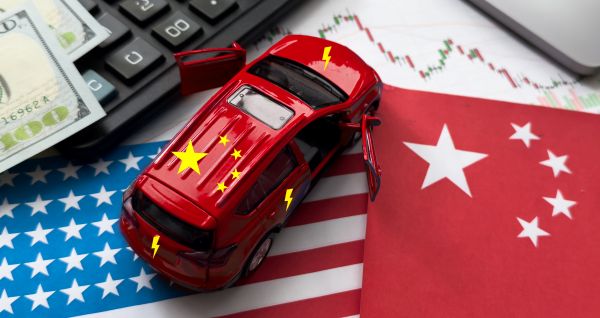
The U.S. Senate Commerce Committee will vote on a bipartisan bill that would effectively ban Chinese companies from selling electric vehicles (EVs) in the United States.
The committee plans to vote on July 15 on a bill that would block Chinese automakers from entering the U.S. passenger-car market. The bill was jointly introduced in April by Republican Senator Bernie Moreno of Ohio and Democratic Senator Elissa Slotkin of Michigan. Its core aim is to write into law regulations introduced by the Biden administration. It would effectively ban Chinese automakers from selling passenger cars in the United States and further restrict Chinese companies from entering the small passenger-car market.
ㆍU.S. plays 'sales ban' card this time... vote on bill to push Chinese EVs out
Tesla has removed an assembly line at its Fremont plant that produced the Model S and Model X, and is converting the space into facilities to produce the humanoid robot Optimus. The line operated for 14 years after mass production of the Model S began in 2012. The Model X has been produced on the same line since 2015. The Fremont plant was previously used by General Motors and Toyota.
ㆍTesla removes Fremont Model S and Model X line... prepares for Optimus production
Tesla's self-driving business is facing a pricing overhaul, controversy over technical reliability and regulatory pressure at the same time. Tesla Korea will switch sales of its supervised Full Self-Driving (FSD) option from a lump-sum payment to a monthly subscription from Aug. 10. Enhanced Autopilot (EAP) will also vary by country of production in terms of whether it can be newly purchased. It is currently sold via a lump-sum payment of 9,043,000 won including VAT, but that option will disappear from Aug. 10 and shift to a subscription of 150,000 won a month including VAT.
Views are also divided on Tesla's self-driving strategy. One contributor pointed out that if Tesla's camera-based approach to self-driving is proven, it could accelerate adoption by rivals, while if it is wrong Tesla alone could face the burden of a full system redesign.
A new variable has emerged for expansion plans as a U.S. regulatory proposal targeting camera-based systems gains traction alongside the structural dilemma in self-driving decision-making. As New Jersey moves to require two additional types of sensors beyond cameras for fully self-driving vehicles, the likelihood has grown that Tesla's camera-only robotaxi system could be blocked there.
ㆍTesla FSD switches to subscription from Aug. 10... lump-sum 9.04 million won to 150,000 won a month ㆍTesla loses if it is right and loses if it is wrong... the nature of the self-driving dilemma ㆍU.S. New Jersey robotaxi regulation proposal gains traction... will Tesla's camera approach be restrained
China has decided to mandate physical buttons for car safety-related functions. The Chinese government has confirmed rules requiring vehicles to include physical controls, with an implementation date of July 1, 2027. The move aims to put the brakes on the screen-centered vehicle interfaces that have spread recently, as automakers have moved various functions to touchscreens.
ㆍChina puts brakes on Tesla-style 'all touchscreen'... mandates physical buttons
South Korean mobility companies are rapidly expanding their business scope, from self-driving maps to content platforms and overseas market pushes. Kakao Mobility and TMAP Mobility are working to strengthen core data competitiveness, while Autonomous A2Z is accelerating global expansion as it pushes ahead in earnest with self-driving commercialisation in Singapore.
ㆍKakao Mobility and Renault Korea jointly develop ADAS maps ㆍTMAP Mobility moves to secure mobility data through short-form content ㆍAutonomous A2Z speeds up commercialisation in Singapore... first local unveiling of ROii
BMW will launch the hydrogen fuel-cell SUV iX5 Hydrogen in 2028. BMW recently unveiled the fifth-generation X5 and presented plans for five powertrains: gasoline and diesel hybrids, plug-in hybrid (PHEV), battery electric (EV), and a hydrogen-powered model. It has not yet disclosed the countries where the hydrogen model will be sold.
ㆍBMW to launch hydrogen SUV iX5 Hydrogen in 2028... why not give up despite a lack of refuelling stations
The European Union is pushing plans to further tighten safety regulations for new vehicles to reduce traffic accidents. As it considers mandating features that automatically reduce speed when a vehicle is speeding and requiring driver face-monitoring cameras, debate is also growing over safety improvements and personal data protection.
ㆍEU considers making it mandatory for new cars by 2030 to slow automatically when speeding ㆍEU to mandate driver face-monitoring cameras in new cars... accident prevention vs privacy infringement
Global bicycle brand Trek has launched the throttle-equipped fat-tire electric bicycle Borego+ and is moving to target the North American e-bike market. The move expands its lineup into the fast-growing fat-tire e-bike market, moving away from a strategy focused on premium bicycles and mid-drive e-bikes.
ㆍTrek launches throttle-equipped Borego+... targets fat-tire e-bike market
 Jinju Hong
hongjj@d-today.co.kr
Jinju Hong
hongjj@d-today.co.kr