
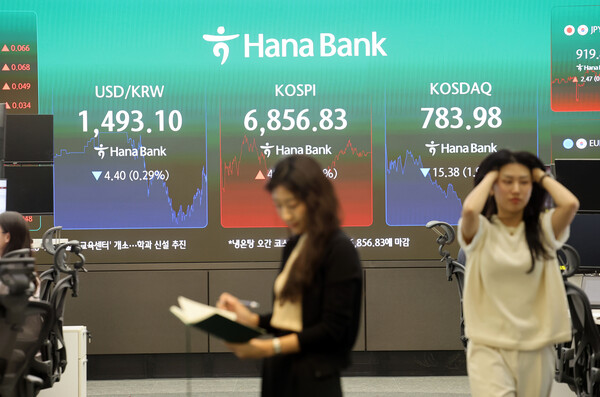
The KOSPI, which plunged nearly 9 percent the previous day, rebounded on bargain buying by foreign investors and institutions. The KOSDAQ, however, failed to regain 800 after a sell sidecar was triggered during the session.
On July 14, the KOSPI closed up 49.90 points, or 0.73 percent, at 6,856.83. The index opened at 6,769.06, down 37.87 points, or 0.56 percent, from the previous session. It rose as high as the 6,900 level during the day but failed to reclaim 7,000.
In the main board market, foreigners bought a net 961.6 billion won and institutions bought a net 3.22 trillion won. Retail investors sold a net 4.15 trillion won, taking profits during the rebound.
Among top market-cap stocks, large semiconductor shares rebounded. Samsung Electronics closed at 263,000 won, up 8,500 won, or 3.34 percent, from the previous session.
SK Hynix rose 68,000 won, or 3.69 percent, to 1,913,000 won. SK Square also gained 2.50 percent.
Samsung Electro-Mechanics fell 2.25 percent. Hyundai Motor, LG Energy Solution, KB Financial Group, Samsung Life and Samsung Biologics were weak, down 4.39 percent, 1.98 percent, 3.33 percent, 2.76 percent and 2.29 percent, respectively.
The KOSDAQ closed down 15.38 points, or 1.92 percent, at 783.98. The index at one point fell more than 5 percent intraday, sliding to the 750 level.
The Korea Exchange activated a sell sidecar in the KOSDAQ market at 12:06:33 p.m. on Tuesday, temporarily halting the effectiveness of program sell orders.
At the time of activation, KOSDAQ 150 futures were down 84.70 points, or 6.08 percent, from the previous session at 1,306.80, and the KOSDAQ 150 index was down 86.69 points, or 6.25 percent, at 1,298.20. The effectiveness of program trading sell orders was halted for 5 minutes.
The KOSDAQ pared losses in the afternoon but did not recover 800, which it had broken the previous day.
The won-dollar exchange rate was 1,493.10 won, down 6.40 won, or 0.43 percent, from the previous session. It fell below 1,490 won during the day, marking the lowest level in about 2 months.
Yang Ji-yoon (양지윤), a researcher at NH Investment & Securities, analysed that a significant portion of net selling by domestic institutions during the recent plunge was related to liquidation of leveraged ETF positions, and that foreign selling was also estimated to have had a strong program and passive character. She said mechanical trading, rather than discretionary judgment, has been moving stock prices, amplifying even small shifts in direction.
She added that foreigners have shifted to net buying in both cash equities and futures, while private equity funds and pension funds have also started buying, with the market's lower-end support shifting from retail investors to foreigners and institutions. She said foreign buying and expectations of currency conversion of funds raised through SK Hynix's U.S. American depositary receipts also appeared to have affected the won's strength.
 Sangyeop Oh
yub@d-today.co.kr
Sangyeop Oh
yub@d-today.co.kr