
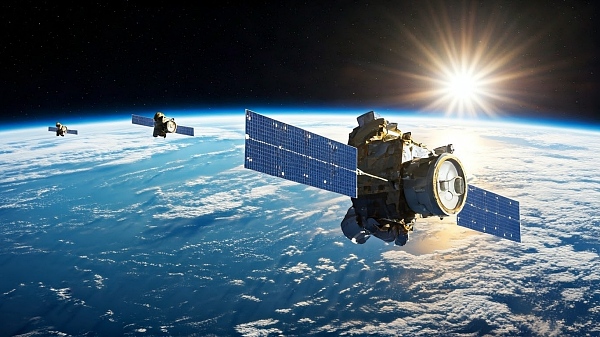
Industry views that space data centres will struggle to become a full-fledged business for the time being resurfaced after a public spat between Sam Altman (샘 알트먼) and Elon Musk.
On July 13, the IT outlet TechCrunch reported that after Musk called Altman a fraud, Altman responded on social media, saying: "You’re the one selling near-term space data centers to public market investors."
The core of the exchange is when a business that launches data centres into space to handle artificial intelligence (AI) inference can realistically take shape. SpaceX is promoting a concept to launch clusters of orbital data centres. Bulls see that processing capacity as something that could support SpaceX AI models or serve as a new orbital cloud. Such expectations are being cited as a key driver supporting SpaceX’s $2 trillion valuation.
But a more cautious view dominates on the ground in the industry. Founders of space data centre startups, Google’s orbital computing project team and engineers who have reviewed related calculations commonly say the cost structure must change first. They judge it will be hard to have a big impact on the market until a system is in place for cheaper rockets and mass production of high-performance satellites at low cost.
Musk’s counterargument could be Starship. SpaceX’s new heavy-lift rocket Starship is expected to attempt its 13th test flight as early as July 16. Expectations are emerging that once Starship enters a phase of repeated operations, the economics of space data centres could also fall into place.
But criticism continues that even a successful test flight would not immediately secure commercial viability. Even if SpaceX recovers both stages of the rocket in this flight, it is highly likely to take several more years to reach an operable reusable flight system. During that period, SpaceX is likely to prioritise NASA-related missions and expanding its own Starlink network.
SpaceX itself also acknowledged in its initial public offering roadshow that Starship might not reach a fully reusable stage in the short term. If it has to discard the second stage for each launch, the economics of space data centres would inevitably deteriorate sharply. Musk countered, saying, "We start flying them next year," but the real issue is not whether the first launch happens next year but when mass launches and manufacturing become possible.
In the end, the issue is scalability, not a technology demonstration. It means that even if SpaceX can launch satellites carrying high-speed data-processing equipment next year, mass-producing them and launching them repeatedly to connect to a business is a different matter. The industry sees the 2030s as the timeframe for space data centres to establish themselves as a real market.
We start flying them next year. Maybe you can come see them if your parole officer approves. After stealing an open source AI charity, you then stole all of Apple’s phone technology! Wow. What do you plan for an encore? That’s tough to beat.
 Seung-a Yoo
ysah@d-today.co.kr
Seung-a Yoo
ysah@d-today.co.kr