
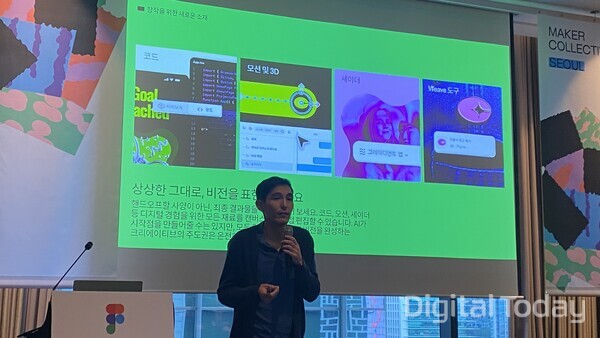
Figma is expanding beyond AI prototyping that creates working prototypes through natural-language commands, moving into a "full-stack creation platform" that connects everything from ideation to design, code and final product production. It aims to link the entire creation process by combining code, motion and AI on a single canvas.
Figma Chief Product Officer Yuhki Yamashita (유키 야마시타) said at a press briefing at the Conrad in Yeouido on July 14, "I hope Figma becomes a full-stack creation space that continues from an idea to a final design and product, without switching work context or making creative compromises."
Figma says it developed this strategy out of a sense that while AI has made it easier to build products, it has become harder to differentiate the results. Yamashita said the number of newly launched apps has surged since AI spread, but the number of apps users return to repeatedly has not increased by the same amount.
He described the tendency to accept AI output as-is as "quiet surrender." "The first app you make may look great, but now that is the new average," he said. "Since anyone can reach that level, you have to think about less obvious answers and push beyond it," he added.
He also pointed to the problem of work fragmenting by individual when using AI. As each person builds prototypes with their own AI agent, outputs and feedback are scattered across multiple tools and shared with the team later, he said. Figma presented a "multiplayer canvas," where people and colleagues' AI agents work in the same space, as a solution.
At the center of the full-stack creation strategy are its existing AI prototyping tool, Figma Make, and the newly unveiled Code Layer. Figma Make creates working prototypes using prompts and existing designs, and it is expanding to a stage where it connects to an actual code repository and submits changes as pull requests.
Code Layer lets users place these code-based prototypes onto the Figma canvas to compare multiple options side by side and revise them. Users can also bring code-built screens into editable design layers and then reflect the changes back into the code. Figma views code not as an output after design, but as a creative material like images and vectors.
Code Layer does not immediately replace finished product code. Yamashita said, "For now, it is closer to a richer specification that describes what you want and a proof of concept that shows what is possible." "There is still a lot of detailed work left to apply it to actual products," he said. Code Layer will begin early access for a limited group of users from July.
Figma has also combined tools on one canvas to increase the expressiveness of prototypes. Figma Motion enables users to create animations using timelines and keyframes and export them as code. Shaders generate visual effects such as light, texture and blur using AI prompts, and then allow users to adjust detailed values directly.
Figma will also gradually integrate Figma Weave into the canvas, linking multiple AI models and image-processing stages. It is designed not to stop at generating an output with a single prompt, but to control lighting, backgrounds, art style and video conversion step by step. The aim is to secure creators' control by having AI produce a first draft and people refine it themselves.
Woo Sang-hoon (우상훈), a lead at Naver's Content Production Tools Lab who attended a panel discussion, introduced that he used Figma Weave in the process of creating service prototypes using generative AI. He said Weave linked AI work stages and finely adjusted results, allowing a small number of developers and designers to quickly define a visual concept and service flow. "With Weave, you can do controlled design," Woo said. "I describe it as a process of elevating design into engineering," he added.
Figma AI agents handle automating repetitive tasks and producing multiple design drafts. It also supports training team-specific design rules and work procedures as "skills," or creating custom plug-ins through natural-language commands. Users can also see colleagues and colleagues' AI agents working on the same canvas.
"Figma's biggest competitive strength is that it was built from the beginning for multiplayer collaboration," Yamashita said. "The goal is to support creating all digital experiences, regardless of the output format, including websites, apps, video and motion," he added.
 Seulgi Son
sageson@d-today.co.kr
Seulgi Son
sageson@d-today.co.kr