
Google is targeting South Korea's AI market by highlighting Gemini Enterprise's full-stack structure and compatibility with other companies' models.
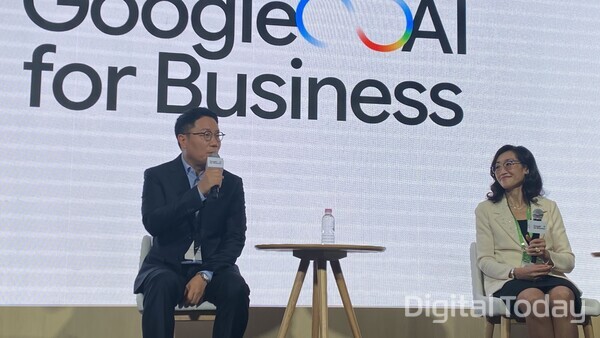
Ruth Sun (루스 선), head of Google Cloud Korea, said at the 'Google AI for Business 2026' media briefing held at Hotel Shilla in Seoul's Jung-gu district on July 14 that Google's differentiation is a full-stack structure that owns every layer from chips to models, and the ability to freely use more than 200 models including Claude, which she said leads to the best return on investment (ROI).
Sun described the Gemini Enterprise structure as 'full-stack AI'. Google has intentionally invested in four layers: computing infrastructure, AI models, an orchestration platform and a user interface (UI).
Sun said the AI stack requires an organic combination of the four layers. She said the four elements are its in-house Tensor Processing Unit (TPU) chips, DeepMind's Gemini model, and the Gemini Enterprise agent platform that integrates with Google Workspace and other tools.
She also cited as a differentiator that it does not force customers to use only Google models. Sun said more than 200 models, including Anthropic's Claude, already run on Gemini Enterprise and more are being added.
She said adopting Gemini Enterprise also leads to tangible results for customer companies. She cited the adoption case of Samsung Electronics' DX division as a representative example.
Sun said Samsung Electronics employees are already using the Gemini Enterprise app as a security gateway to access internal data. She said employees' work styles are shifting from simple information searches to active problem-solving.
She added that Gemini Enterprise is becoming a foundation for Samsung to prepare AI agents that will autonomously handle work in the future. She said Samsung activated the service within 24 hours of signing the contract.
Sun also said Google is one of the largest users of Gemini Enterprise globally, which also contributes to customer efficiency. She said more than 5 million people use the platform across YouTube, Chrome and Android.
Google is strengthening companies' threat prevention capabilities by combining Wiz, the security firm it acquired earlier this year, Google Security Operations, a security operations platform that began support last month in its Seoul region, and Mandiant's threat response capabilities.
Yoon Goo (윤구), head of Google Korea, introduced examples of expanding AI use in marketing and sales. According to Yoon, 76 percent of South Korean consumers first use AI search and multimodal search tools when they get ideas for new products.
He said Google is supporting business innovation for various South Korean companies in the era of agent AI. He said Google will continue to lead changes in working methods together with its partners in South Korea.
The event is being held over three days by integrating Google's annual marketing event 'Google Marketing Live' and the Google Cloud event 'Google Cloud AI Live+Labs'. Google is also introducing AI use cases by South Korean companies including CJ Olive Young (retail), KakaoBank (finance), Daewon Pharmaceutical (healthcare), Weverse (media and entertainment) and Yeogi Eottae (travel).
 Seulgi Son
sageson@d-today.co.kr
Seulgi Son
sageson@d-today.co.kr