
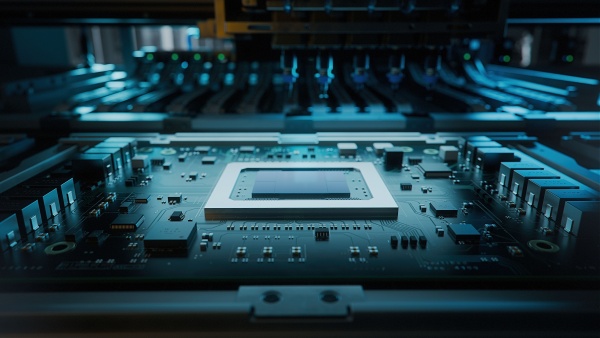
An integrated circuit has been developed that operates on its own by drawing power only from ambient light without a battery, and detects chemical substances and performs computing. By integrating the sensor, computing unit and power supply into a single chip, the structure has been presented as having potential applications in the internet of things (IoT) and edge computing, where replacing batteries can be difficult.
On July 13 local time, IT outlet TechRadar reported that a research team at Pennsylvania State University developed a self-powered integrated circuit that can perform sensing and computing using only solar power.
The core of the research is that it moved away from the conventional approach of building the sensor, computing circuit and power supply function as separate chips, and instead stacked them vertically within a single chip.
The researchers focused on integrating the functions into a single structure rather than connecting multiple semiconductor dies, reducing substrate area and wiring length, and minimising power loss and signal delay.
The chip consists of three layers. At the top, a graphene-based sensor detects chemical substances in liquid and converts them into electrical signals. The middle layer contains semiconductor logic circuits that process signals delivered from the sensor. The bottom layer uses a silicon solar cell (photovoltaic cell) to convert ambient light into power and supply energy to the overall system. To realise this structure, the researchers integrated two-dimensional semiconductor materials such as molybdenum disulfide (MoS2) and tungsten selenide (WSe2), along with graphene and a silicon solar cell, into a single three-dimensional structure.
Co-author Saptarshi Das (삽타르시 다스), a professor at Pennsylvania State University, explained: "We implemented a self-powered system that simultaneously performs sensing, computing and energy harvesting by integrating different materials such as silicon and graphene, and MoS2 and WSe2, into a single three-dimensional structure." He stressed: "The biggest difference is that instead of connecting separate chips as before, we placed sensing, computing and energy harvesting functions within nanometre-scale close distances."
The researchers explained that integrating functions into one chip not only reduces chip size but also shortens interconnect wiring length, reducing power loss and signal delay. Das said: "If we pack sensing, computing and energy harvesting functions at the nanoscale, we can reduce area and interconnect length, and energy efficiency increases accordingly."
The research is drawing attention because it coincides with the expansion of the IoT and edge computing markets. In environments that are difficult to access, such as remote sensors or industrial IoT devices, it is not easy to replace or recharge batteries. As a result, low-power semiconductor technology that can operate for a long time without an external power source has been regarded as a key task.
The researchers assessed that while the chip is still at the level of a small circuit optimised for a specific purpose, it is meaningful in that it presents a direction for developing battery-free electronic devices.
They also said that as interest grows in 'battery-free' electronic devices that use renewable energy, a new design approach that binds the sensor, computing unit and power source into a single integrated circuit could expand to various applications. The researchers expect the same structure can be applied to more complex circuits or remote IoT devices in the future.
The technology does not immediately replace general-purpose processors. The researchers forecast that it is likely to be used first in areas where battery replacement is difficult, such as low-power, ultra-small circuits and IoT systems for remote environments.
In the industry, there is growing demand for semiconductors that minimise power consumption while operating autonomously for long periods as AI and IoT devices spread rapidly, and attention is focused on whether this research can become a foundational technology for developing next-generation self-powered integrated circuits.
 Jinju Hong
hongjj@d-today.co.kr
Jinju Hong
hongjj@d-today.co.kr