
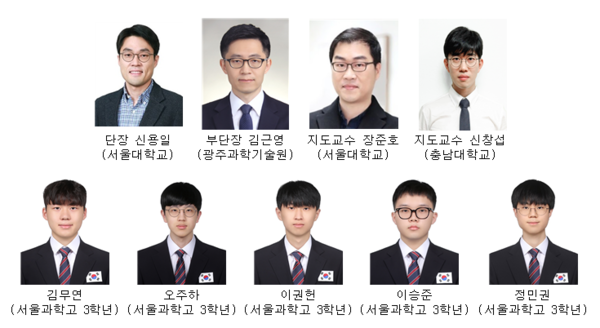
All members of South Korea's delegation to the International Physics Olympiad won gold medals. The delegation to the International Young Physicists' Tournament also won a gold medal for the first time in 8 years since 2018.
The Ministry of Science and ICT and the Korea Foundation for the Advancement of Science and Creativity said on Monday that all 5 members of the South Korean delegation won gold medals at the 56th International Physics Olympiad, held from July 4 to 12 in Bucaramanga, Colombia.
A total of 381 students from 91 countries took part. The South Korean representatives Mu-yeon Kim (김무연), Ju-ha Oh (오주하), Kwon-heon Lee (이권헌), Seung-jun Lee (이승준) and Min-gwon Jung (정민권) all won gold medals. Oh ranked first overall among all participants. It is the first time since the 2023 competition in Tokyo that all 5 members of South Korea's team have won gold at the International Physics Olympiad.
The competition consists of a 5-hour theory exam and a 5-hour experimental exam. The theory exam included questions on principles such as low-temperature cooling using magnetic materials, light concentration and solar cookers. The experimental exam assessed the ability to measure vapour pressure and thermal conductivity.
Yong-il Shin (신용일), chairman of the Korean Physics Olympiad Committee at the Korean Physical Society, said, "I am happy to achieve the outstanding result of the entire South Korean team winning gold medals." He added, "I hope they will nurture their dreams and capabilities for science and grow into talent that will lead the future."
South Korea's delegation also won a gold medal at the 39th International Young Physicists' Tournament, held in Zurich, Switzerland, from July 5 to 12. It is the first time in 8 years since the 2018 competition in Beijing that South Korea has won gold in the tournament.
The International Young Physicists' Tournament is a debate-format competition in which up to 5 students per country form a team, present physics research topics with no set answers, and respond to opposing teams' rebuttals and critiques. A total of 175 students from 35 countries took part in this year's tournament.
South Korea's team comprised Dong-ha Kim (김동하), Seung-hyun Kim (김승현), Han-seo Kim (김한서), Jae-hyun Won (원재현) and Si-woo Choi (최시우). The team advanced to the final after placing second overall behind Singapore with a total of 207.6 points across 5 main-rounds, and then won the gold medal.
The team researched and presented everyday physics phenomena, including a sudden change in the axis of rotation of an object thrown into the air, the motion of a coin in a liquid as it sways like a falling leaf while sinking, and Newton's cradle using magnets.
Ji-su Byun (변지수), head of South Korea's delegation to the International Young Physicists' Tournament, said, "The students carried through to the end the process of experimenting and debating day and night, creating questions on their own and finding answers." She added, "It is highly meaningful in that they learned the joy and attitude of science by deeply exploring problems with no set answers."
 Jin-ho Lee
jhlee26@d-today.co.kr
Jin-ho Lee
jhlee26@d-today.co.kr