
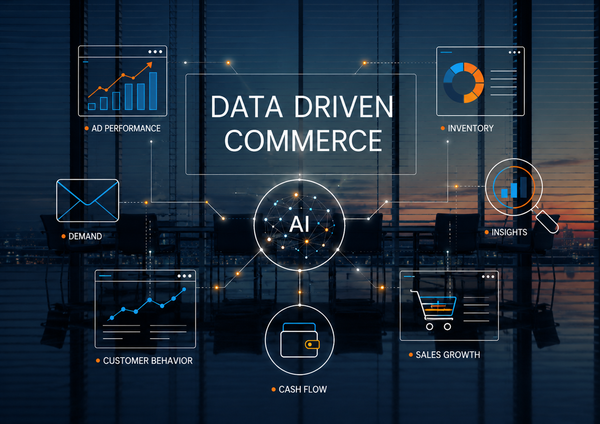
South Korea's online shopping transaction value is growing every year, but sellers' profitability is not improving. That is because ad costs rise annually while losses from stockouts and excess inventory remain. Cafe24 plans to change this structure with a "total commerce marketing" system that links advertising, inventory and finance data into a single flow.
According to the Korea Statistical Information Service (KOSIS), South Korea's online shopping transaction value in 2025 was 274.9442 trillion won, up about 12.5 trillion won from a year earlier. The market size is setting new records each year. But sellers running shopping malls say it feels different. They say that even as sales trend upward, actual profit stays flat while ad costs rise. This is the backdrop to the repeated question: "Sales are rising, so why isn't profit increasing?"
The cause lies in a structure in which advertising, inventory and finance are managed separately, without being linked. Sales at an online shopping mall are not made by advertising alone. When advertising creates demand, inventory must meet it, and financing must support replenishing inventory and running ads. Only when the three elements work together does sales remain as profit.
The problem is that, at most shopping malls, the three pillars move separately. If advertising is scaled up, inventory cannot keep pace. Even if demand is created, if the product is out of stock it becomes lost opportunity rather than sales. Conversely, conservative inventory misses sales opportunities, while holding ample inventory becomes a cost. Ad spending is prepaid, so costs go out before sales occur. Sellers short of cash struggle to get even the chance to verify advertising effectiveness.
These structural losses can also be seen in figures. According to an inventory distortion analysis published by IHL Group in 2024, the offline retail industry suffered losses of about $1.7 trillion in 2024 alone due to stockouts and excess inventory. Losses from stockouts were $1.2 trillion, while excess inventory losses were $554 billion.
The survey covered offline retailers, but online shopping malls are similar under the same structure. The same losses occur the moment ads are run for out-of-stock products or budgets are put into inventory with low sales potential. It means that a significant share of sales is not converted into profit while advertising that creates demand, inventory that fulfills it, and financing that runs it are managed separately.
As a result, the center of gravity in e-commerce operations is also shifting. It is moving from a scale competition of spending more on ads to an approach that links and operates advertising, inventory and finance on a single data flow.
The effect of data-driven operations is also confirmed in global surveys. According to a DoubleVerify and Sapio Research survey, 46 percent of marketers use artificial intelligence to optimize bidding and execution processes. That is up 5 percentage points from 41 percent a year earlier. In inventory, McKinsey analyzed that AI-based demand forecasting reduces forecast error by 20 to 50 percent and cuts sales losses from stockouts by up to 65 percent.
Cafe24 focuses on the point that the effect is greater when the two areas are used together rather than operating separately. It says inventory data must identify which products contribute to actual profit to determine what to advertise, and the burden of prepaid ad spending must be eased to execute that decision without delay.
FINANCE, INVENTORY AND ADVERTISING LINKED IN THREE STEPS... INVENTORY TURNOVER 9.2 TO 20.7 TIMES A YEAR, ZERO STOCKOUTS
Cafe24's marketing center designed the structure in three steps. It made it possible to link stages progressively, from entering advertising through expansion and optimization, in line with a brand's growth stage.
The starting point is financing. "Sales-linked advertising" is a structure in which ad spending is executed first and settled after sales occur. It removes the initial cash burden so advertising effectiveness can be verified first. It changed the existing structure in which costs are paid out before performance is confirmed.
Once the financing issue is resolved, the next question is which products to advertise. "Inventory data-based marketing (AIM)" addresses this stage. It analyzes sales data and inventory data together to decide at the same time which products to run ads for and how much to order. It is designed to reduce situations such as spending ad budgets on out-of-stock products or leaving piled-up inventory unattended.
The final step is execution precision. The "NextGen" marketing solution combines big data and AI to automatically generate ad creative and analyze performance in real time to adjust operating strategy. Cafe24 said it is a structure that reduces ad budget leakage and creates more conversions with the same budget.
Cafe24 said performance differences appeared in cases applying the three services together. Fashion brand "Kikiko" cut ad spending by 12 percent in the off-season but conversion sales rose 29 percent, and return on ad spend rose to 855 percent from 579 percent. "Pixem" improved a structure marked by cash shortages and frequent stockouts, and in the same period sales increased about 3.8 times and purchase transactions rose about 5.8 times. Company A, which integrated operations of advertising, ordering and inventory under a single operator, raised annual inventory turnover to 20.7 times from 9.2 times and recorded zero stockouts.
Cafe24 said these were cases in which more sales were generated at the same cost by linking data, rather than as a result of increasing the ad budget.
The challenge is how to implement scalability. It is important to verify whether the same effect can be reproduced for sellers of various sizes and industries beyond individual brand cases. Cafe24 said that when advertising, inventory and financing mesh on the same data, profit that had been hidden behind sales becomes visible. In a market that has grown to 274 trillion won, whether what sellers need is a bigger budget or a more precise linkage is expected to be the next competitive dividing line.
 Daegeon Seok
d2dg@d-today.co.kr
Daegeon Seok
d2dg@d-today.co.kr