
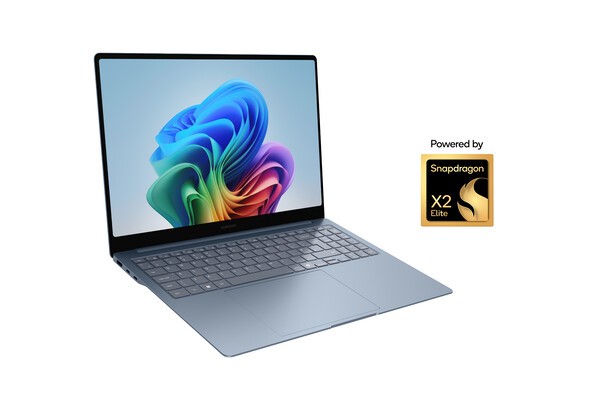
Samsung Electronics is developing a PC chip called Gaia for the first time in more than 10 years, drawing attention to the reasons behind the move. The timing coincides with its Galaxy Book6 Edge laptop being powered by a Qualcomm Snapdragon chip.
The System LSI division is developing Gaia, an AI PC chip based on a 4-nanometre process, and is discussing supplies with some PC makers with a goal of mass production as early as next year, industry sources said on July 14. Samsung in 2012 put Exynos chips into Chromebooks but withdrew two years later.
The PC chip market is already fiercely competitive. Qualcomm is seeking to expand market share across the range from entry-level to premium. The Snapdragon C platform unveiled in May targets entry-level laptops in the $300 range, and major manufacturers such as Acer, HP and Lenovo will launch products using it in the second half of this year. At the premium end, the Snapdragon X2 Elite entered in June with an AI computing performance of 80 trillion operations per second, or 80 TOPS. Intel and AMD from the x86 camp are also responding by rolling out chips with next-generation NPUs and diversifying their high-performance lineups.
What makes this market structure more complex is that Samsung is both a competitor to Qualcomm and a customer. Devices equipped with the Snapdragon X2 Elite include Samsung's Galaxy Book6 Edge. Samsung is developing its own chip while entrusting the brains of its premium laptop to a rival, making it hard to view Gaia purely through the profit and loss of the PC chip business. Whether the Galaxy Book lineup has an in-house chip option changes the cost structure itself.
This structure has already been seen in smartphones. The Exynos 2200 used in the Galaxy S22 in 2022 and Qualcomm's Snapdragon 8 Gen 1 were both produced using Samsung Foundry's early 4-nanometre process. Both chips, however, suffered overheating as power efficiency and yields failed to meet design requirements, and it spilled into controversy over GOS, the Game Optimizing Service, which forcibly lowered performance.
Qualcomm promptly moved production to TSMC's 4-nanometre N4P process. The Snapdragon 8+ Gen 1 and Snapdragon 8 Gen 2 that followed widened the gap with Samsung-made products in performance per watt and stability. It was a phase that confirmed that manufacturing process maturity can determine outcomes even with similar designs.
The result was the adoption of Snapdragon across the entire Galaxy S23 lineup in 2023. Samsung's own chips were completely excluded from its flagship devices. Industry officials explained that losing an alternative also eliminated price negotiating power, leading to a structure in which annual application processor purchase costs increased.
◆PC chip race marks start of a fight for control of physical AI
The next stage of the competition lies outside the PC. The recent focus in AI infrastructure has shifted to real-time inference. According to Kiwoom Securities, uplink accounts for about 10 percent of total mobile networks, but ChatGPT is 29 percent and agentic AI is close to 50 percent. That is because users are increasingly uploading images and video to AI.
Kiwoom Securities projected that AI-RAN, which processes AI at base stations, will emerge to reduce latency. It also analysed that as processing by edge devices increases, the role of CPUs and NPUs, which had remained in supporting roles, will inevitably rise in the inference domain instead of expensive GPUs.
At the centre of this structure is ARM. Nvidia introduced the ARM-based Vera CPU, Amazon Web Services unveiled Graviton5 based on Neoverse cores, and Microsoft introduced Cobalt200. ARM's data centre royalty revenue is expected to double from a year earlier. In edge AI, a complex system-on-chip integrating an NPU and CPU is becoming the standard, and the same SoC architecture goes into cars and robots. Nvidia's Jetson platform is also ARM-based.
Against this backdrop, Samsung's process of transplanting NPU optimisation capabilities proven in Exynos into a PC SoC can be read as building an ARM-based lineup linking smartphones, PCs and robots. It is also possible to interpret AI PCs as the consumer touchpoint in the era of real-time inference. Qualcomm is also following the same path with its self-driving Snapdragon Ride and humanoid Dragonwing IQ10, so the PC chip race can be seen as the start of a fight for control of physical AI.
An industry official said, "From the perspective of negotiating competitiveness, it is important to have in-house products," but added, "If Gaia is to avoid the trial and error that Exynos went through, we need to see how the mass production timing and the memory supply situation align."
 Daegeon Seok
d2dg@d-today.co.kr
Daegeon Seok
d2dg@d-today.co.kr