
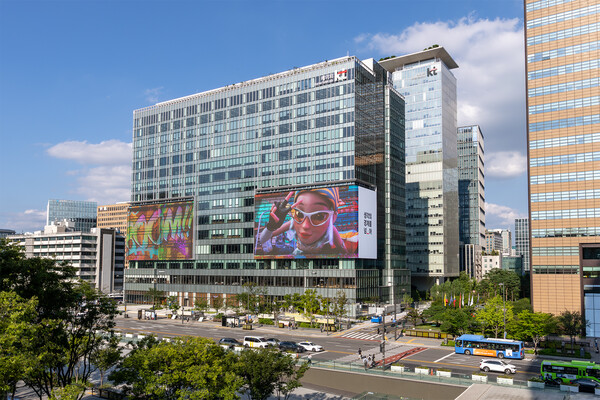
KT is making its management direction clearer as it passes 100 days since CEO Park Yoon-young (박윤영) took office. An “AX platform company” that supports corporate customers’ AI transformation is emerging as its new banner, rather than the in-house AI model and partnerships with overseas big tech that were pushed under the previous CEO.
Park took office on March 31 and marked 100 days in the role on July 9. A more than 30-year veteran at KT, Park is seen as a leading business-to-business expert. He has stressed the telecoms core business, the field and execution from the outset. He cut executive-level organisations by about 30 percent and overhauled information security and network teams as part of a push to change the company’s makeup.
A telecoms industry official said Park is known as a manager who places importance on linking revenue to the actual business site. The official said boosting execution in the B2B business after his appointment also appears to reflect that tendency.
◆ Emphasis on an 'AX company'…shift toward B2B
Park has shifted the company’s direction toward AX and B2B. KT recently said at a press briefing it plans to invest 12 trillion won in information security, IT innovation and next-generation networks, and 6 trillion won in AI data centres and subsea cables. It also presented as a new growth engine a “token factory” that will secure an additional 1 gigawatt of AI data centre capacity nationwide and support companies in choosing AI models and computing resources based on cost and performance.
The token factory, in particular, is a business that symbolically shows the direction KT is pursuing under Park. The concept is to connect multiple AI models and infrastructure to find the combination best suited to a customer’s token use, and to manage usage and costs. As corporate token costs rise with increased AI use, it means KT aims to provide a total solution by bundling its network, cloud and data centre infrastructure.
The key point is that KT is becoming closer to a company that provides bundled infrastructure and solutions so companies can adopt and operate AI, rather than competing on the AI model itself. An analysis has emerged that Park’s experience leading KT’s enterprise business division and dealing with public-sector, financial and large corporate customers influenced that choice.
A cloud industry official said companies consider costs, security, where data is stored and integration with existing systems when using AI solutions. The official said KT, with cloud and data centre capabilities, could find a breakthrough by targeting the B2B market rather than selling its own model.
A difference is also felt from the leadership of former CEO Kim Young-seob (김영섭). Kim promoted an “AICT company” combining telecoms with IT and AI, and presented its in-house large-scale AI model “Mi-deum” and a strategic partnership with Microsoft as growth strategies.
But the market response did not follow as quickly as expected. The in-house model had meaning in demonstrating technological capability, but there were no clear cases of linking it to a flagship service or large revenue. The Microsoft partnership also drew attention mainly for a large-scale investment plan and long-term contract structure, and criticism continued that results in customer acquisition and profit creation were hard to feel.
Questions also grew over whether it is efficient for a telecoms company to pour large resources into competing in general-purpose large language models as global big tech and domestic AI companies compete on model performance and price. KT also suffered setbacks, such as failing to make the elite team selection for the Ministry of Science and ICT-led “independent AI foundation model” project, and has at times been assessed as lagging in in-house model competitiveness.
◆ In-house AI model also stresses enterprise specialisation…task is differentiation
The industry analyses that KT under Park has entered something of a pause. It has not abandoned its in-house AI, but has adjusted its centre of gravity toward AI consulting and infrastructure businesses that can be applied to actual corporate work, rather than putting the model itself front and centre.
KT recently received AI reliability certification for its enterprise model “Mi-deum K 2.5 Pro,” with 32 billion parameters, and also stressed that it will support corporate customers’ AX transformation in that context. It will continue developing its own model, but has tailored its use to the B2B market.
The Microsoft partnership is also not a card that can be overturned immediately. An industry official said the Microsoft cooperation cannot be reversed because investments and contracts are already under way. The official said the partnership’s success or failure will ultimately be decided by how many business cases and how much revenue it produces.
KT also said at the press briefing it plans to expand cooperation not only with Microsoft but also with global AI companies such as Google and Palantir Technologies, and with promising domestic AI companies such as Upstage, Rebellions and Saltlux. It means KT aims to broaden its cooperation structure by combining diverse AI models and infrastructure for customers rather than relying on a specific company or model.
Differentiation from rivals remains a task. SK Telecom is accelerating infrastructure expansion with an “AI full-stack” strategy that links AI semiconductors to data centres and cloud services through partnerships with global operators including Nvidia. LG Uplus is pushing customer-facing AI services, including “Iksio,” and its agent business.
KT highlights as strengths its B2B customer base and the fact it has networks, cloud and data centres. Still, criticism has emerged that it must prove with specific products and business cases how an “AX platform company” differs from existing systems integration or cloud businesses.
An industry official said KT will be able to earn an assessment that it has succeeded in a genuine change in its makeup only if it can disclose visible results as an AX platform company.
 Jin-ho Lee
jhlee26@d-today.co.kr
Jin-ho Lee
jhlee26@d-today.co.kr