
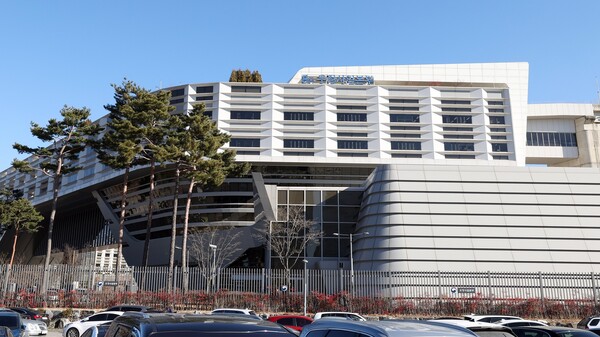
Postmen at South Korea's post office are expanding their role as the “last mile” of national administration, carrying out tasks ranging from identifying welfare blind spots to administrative surveys.
Korea Post said on Saturday the post office shifted in 2022, after introducing “welfare mail”, from a one-off public role focused on disaster response to a permanent delivery system for welfare and administrative services. In May, an amendment to the Act on Special Cases Concerning the Operation of Postal Services also provided a legal basis to pursue public projects as part of postal services’ core work.
Korea Post has played a social safety net role in national crises by using its nationwide postal network, including collecting radon bed mattresses, supplying public masks during COVID-19 and delivering home treatment kits.
Welfare mail expanded...postmen also deployed for statistical surveys
“Welfare mail”, in which postmen visit households suspected to be in crisis and check on their wellbeing, had reached about 290,000 households in 107 cities, counties and districts nationwide through the first half of this year. Of those, 110,000 households were linked to welfare services.
It recently expanded monitoring targets beyond older people to include “isolated and withdrawn youth”. The “wellbeing care postal service”, which delivers daily necessities while checking on recipients, has supported about 110,000 households cumulatively in cooperation with 56 local governments. Since June, it has been running “visiting Just Dream” in Bucheon, Gyeonggi Province, linked to the Ministry of Health and Welfare’s “Just Dream”, which provides food and necessities without separate proof or an application process.
In Gangjin, South Jeolla Province, it operates “senior lunchbox delivery”, delivering side dishes once a week to older people with limited mobility. In 19 counties in Gangwon and North Jeolla provinces, it is also promoting “National Pension safe delivery”, in which postmen deliver the national pension in cash to elderly pension recipients and check on them.
Administrative work using postmen’s on-the-ground access and trust is also expanding. Korea Post will deploy postmen for national statistical surveys in cooperation with the National Data Agency. After preliminary tests, it plans to take part from November in the trial survey for the “basic household and housing survey”.
With the Ministry of SMEs and Startups, it is promoting a project in which postmen check on site whether small business owners who received support for store demolition costs have actually closed and carried out demolition. Korea Post expects survey costs could be reduced by 35.7 percent in the Seoul metropolitan area and by up to 71.5 percent outside the capital region compared with using existing field surveyors. From next month, it will also begin a joint project with the Ministry of Patriots and Veterans Affairs to find bereaved families of those killed in the Korean War, deliver commemorative plaques and survey satisfaction with veterans registration cards.
Resource circulation expanded...support for collection of unused medicines and e-cigarettes
It is also actively pushing environmental projects using the postal network. A project that collects unused medicines through post boxes and dedicated collection boxes has been implemented in 65 cities, counties and districts nationwide, with 210,000 bags recovered cumulatively.
Since January, it has been collecting used e-cigarette devices by mail and delivering them to recycling companies. Projects are also under way to collect plastic bottles discarded in national parks and turn them into water bottles, and to recycle aluminium cans collected by volunteer centres in South Jeolla Province into steel deoxidisers and other materials.
Korea Post plans from the second half to expand local welfare projects, such as senior lunchbox delivery in Gangjin, focusing on areas at risk of population decline. It will also identify additional cooperation tasks with central government ministries and local governments that have demand for in-person administrative work such as field surveys and on-site verification.
Korea Post chief executive Park In-hwan (박인환) said, “We will use the post office’s unique human and physical networks to make a leap into an integrated government platform that resolves welfare, administrative and environmental blind spots across South Korea.”
 Jin-ho Lee
jhlee26@d-today.co.kr
Jin-ho Lee
jhlee26@d-today.co.kr