
[DigitalToday reporter Sangyeop Oh] South Korean stocks this week are expected to test whether a rebound following a sharp plunge can be sustained. U.S. inflation, semiconductor earnings and the Bank of Korea's Monetary Policy Board meeting are key variables that will determine market direction.
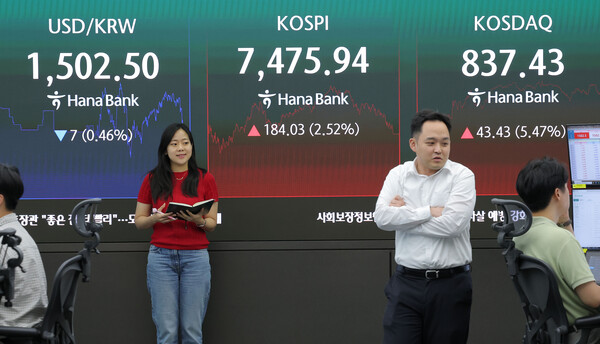
The KOSPI closed on the 10th at 7,475.94, up 184.03 points, or 2.52 percent, from the previous trading day. It plunged on the 7th and 8th as debate over a semiconductor peak and foreign selling overlapped after Samsung Electronics released preliminary earnings, but it rebounded late in the week on bargain buying. Still, it fell more than 7 percent over the week, leaving volatility concerns in place.
U.S. stocks edged higher on expectations for AI growth. On the 10th (local time), the Dow Jones Industrial Average closed up 149.60 points, or 0.29 percent, at 52,637.01. The S&P 500 gained 31.73 points, or 0.42 percent, to 7,575.39, and the Nasdaq rose 77.20 points, or 0.29 percent, to finish at 26,281.61.
The recent sharp fall in South Korean stocks is seen as reflecting elevated expectations and unstable supply and demand at the same time rather than weak earnings. Samsung Electronics announced preliminary second-quarter results of 171 trillion won in revenue and 8.94 trillion won in operating profit, but its shares fell instead.
Concerns that the growth rate of semiconductor profits could have passed its peak weighed more than the record results.
Foreign selling also amplified the index decline. Foreign investors net sold about 10.4 trillion won of KOSPI shares from July 2 to 8, with most of it concentrated in semiconductors.
Foreign ownership in the semiconductor sector has fallen to around 49 percent, approaching post-2013 lows. Another analysis says the amount of stock that can be reduced further may have fallen compared with the past.
Price adjustments have also progressed significantly. Among KOSPI 200 constituents, 89 percent are down more than 30 percent from their yearly highs.
That is higher than during the Federal Reserve's policy rate hikes in 2022. This backdrop is cited for the view that the market has entered a short-term oversold zone as even stocks with maintained earnings outlooks fell together.
The first key test this week is U.S. June CPI data due on the 14th. The market expects headline CPI to rise 3.8 to 3.9 percent year on year, slowing from 4.2 percent in May. Core CPI is forecast at 2.9 percent, unchanged from the previous month.
If CPI meets expectations or comes in lower, the burden of rising rates could ease and lend support to a KOSPI rebound. Past trends show the KOSPI's average monthly gain is higher when U.S. CPI comes in below estimates than when it exceeds them.
If CPI is higher than expected, concerns about U.S. rate hikes could grow again, shaking semiconductors and growth stocks.
U.S. producer price data due on the 15th will also be watched for inflation trends. If cost pressures at the production stage come in high after consumer inflation, concerns could grow that the Fed will keep tightening for longer. Global oil prices have stabilised recently, but June inflation may not have fully reflected the impact of falling oil prices.
Semiconductor companies will continue to report earnings. ASML will release second-quarter results on the 15th and TSMC on the 16th. Their orders and outlooks are indicators of whether investment in AI semiconductors is translating into actual demand for equipment and foundry services.
If ASML and TSMC present results and guidance that meet market expectations, worries that Samsung Electronics and SK Hynix earnings have peaked could ease. If equipment orders or capital spending plans fall short, debate over a slowdown in AI investment could intensify again.
Recent reports that Meta plans to double its 2027 computing capacity to 14 gigawatts from its existing plan and pursue in-house production of AI semiconductors are positive. This can be interpreted as meaning big tech companies are continuing to expand infrastructure by improving investment efficiency rather than cutting AI capital spending.
The Bank of Korea's rate-setting meeting on the 16th is also a factor for South Korean stocks. The policy rate is currently 2.50 percent, but the market is also discussing the possibility of a 0.25 percentage point hike, considering an economic recovery, a high exchange rate and instability in real estate prices. If rates rise, it could be positive for financial stocks, but it could weigh on KOSDAQ growth shares and overvalued stocks.
Ultimately, the key question this week is whether U.S. CPI can reduce rate jitters and whether ASML and TSMC results can confirm that AI demand is holding up. If inflation stays within the expected range and semiconductor companies offer positive outlooks, the KOSPI could try to rebound toward levels seen before the sharp drop.
If both inflation and earnings miss expectations, the market may test the lower end of its trading range again.
Jeonghwan Na (나정환), a researcher at NH Investment & Securities, said, "The current correction is closer to pricing in concerns about a slowdown in profit growth and capital spending rather than damage to fundamentals." He said, "We see it as an oversold zone where selling pressure was amplified by liquidation of some leveraged funds."
Jaeman Lee (이재만), a researcher at Hana Securities, said, "U.S. CPI must meet or come in below estimates for the likelihood of a short-term index rebound to increase." He said, "There is a need to take interest in semiconductors and defence, power equipment, shipbuilding, hardware and brokerage sectors."
 Sangyeop Oh
yub@d-today.co.kr
Sangyeop Oh
yub@d-today.co.kr