
[DigitalToday reporter Seulgi Son] The government will apply a "moving target" approach to a 1.4 trillion won physical AI research and development programme. The method allows research directions and execution systems to change as technology evolves. The government aims to receive proposals from the contest stage on how applicants will detect technological change and, if needed, adjust execution plans, participating organisations and budgets.
Lee Jun-woo (이준우), project manager for the physical AI programme at the National IT Industry Promotion Agency (NIPA), said at a briefing session on July 10 at Nuritkum Square in Seoul's Sangam district that the keyword physical AI emerged less than 2 years ago but the projects run for 4 years and 5 months. No one can be sure whether current technology will remain mainstream even 2 years from now, he said.
The Jeonbuk and South Gyeongnam physical AI R&D projects will run from 2026 to 2030. The Jeonbuk project totals 730 billion won, combining about 515 billion won in central government funding, about 86.1 billion won in local funding and private-sector contributions. The South Gyeongnam project was designed at 670 billion won in total, including about 405.8 billion won in central government funding.
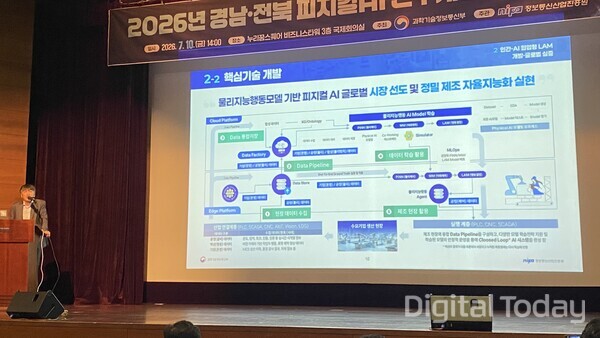
The final goal of the two projects is to create a Korean reference for autonomous factories in which the entire plant is run by AI. They will standardise on-site data and connect the Physical Intelligence-Action Learning and Action Model (PI-LAM), digital twins, and software-defined factory and operations control systems (SDF-OCS) to integrate operations across equipment, processes, logistics and quality. The plan is to spread this as a "K-AI factory" package that can be applied to factories at home and abroad.
The projects consist of 35 sub-tasks in total. The South Gyeongnam project grouped 23 sub-tasks into 5 contest units covering manufacturing process data collection and demonstrations, data pipelines, PI-LAM, testbeds and standardisation. The Jeonbuk project will solicit bids in 6 units for 12 sub-tasks covering factory operations platforms and digital twins, foundation models, logistics and security, and testbeds and technology diffusion. For integrated tasks, lead and sub-task participants must apply as a single consortium.
◆Breaking away from fixed R&D plans… changes to follow technology trends
In this contest, the government asked applicants to propose methods for detecting technological change and adjusting research directions. Lee said in his briefing that the specificity of such plans will also be reflected in evaluations for selecting executing organisations.
Lee cited a shift in the technology trend from vision-language-action models (VLA) to world-action models (WAM) as an example, saying it is not possible to carry out an existing plan as-is when the direction of technology has changed. He added that if a moving-target setting method is deemed valid, execution plan changes will be reflected after selection. Participating organisations and budgets will also be changed flexibly, he said.
NIPA plans to form a consultative body involving lead and sub-task leaders and local governments to discuss technological changes, linkages among tasks, and the need to change participating organisations and budgets.
◆More emphasis on factory operations and data than humanoids
The programme focuses on implementing integrated intelligent factory operations technology, rather than on some physical AI hardware or models.
Lee said he has little interest in humanoids and grippers, and robot foundation models are also not a focus. He said the emphasis is on SDF-OCS, which autonomously operates complex factory environments.
A substantial budget was also allocated to data collection and data movement and management. The projects will combine manufacturing site data with synthetic data and build a data pipeline that moves data between the edge and the cloud. The structure also includes detecting changes in data caused by equipment ageing and wear and retraining models.
Lee said data is viewed as the most important element in physical AI. He said a significant share was allocated to the data pipeline because large-scale data must move beyond the laboratory level.
In evaluations, the weight of past R&D performance will be reduced, while demonstrations and commercialisation, challenge level and alignment with regional policies will be strengthened. The South Gyeongnam project must meet private-sector contributions of at least 40 percent of total R&D costs, while the Jeonbuk project must meet at least 30 percent.
◆Concerns about large companies dominating large consortiums
Some at the event also raised concerns that consortiums could be formed around large companies due to the scale of tasks and the integrated contest format. In the South Gyeongnam project, the manufacturing site data collection and demonstration field requires 13 sub-tasks to be bundled into a single consortium for application. Critics said it would be difficult for small and medium-sized firms to serve as lead organisations because they must coordinate multiple technologies and participants at the same time.
A company official who attended the briefing session pointed out that it is difficult to form a consortium to carry out 13 tasks within a short contest period. Only a few large companies can take on the lead role, the official said, adding that it could become a project for a handful of large firms.
A NIPA official responded that bundling the contest was unavoidable to secure project integration and consistency among tasks. There are no separate restrictions on the same company participating in multiple tasks, the official said, but NIPA plans to examine the appropriateness of each organisation's role and participation during the evaluation process.
Companies attending the briefing session included MegazoneCloud, Naver Cloud, LG Electronics, LG CNS, Enhance, RaonSecure, PersonaAI, KT, RealWorld, Flitto and Aim Intelligence. A Naver Cloud official said the company is willing to participate across physical AI, particularly in models and infrastructure, and is sounding out consortium participation with good companies.
 Seulgi Son
sageson@d-today.co.kr
Seulgi Son
sageson@d-today.co.kr