
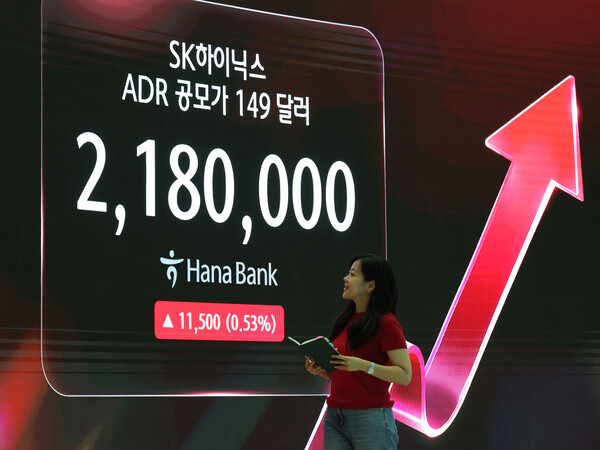
SK Hynix will enter the Nasdaq market on July 10 local time. Expectations are rising for a broader global investor base and a re-rating of the company’s value. But examples of South Korean companies that listed earlier on Nasdaq show that an American depositary receipt (ADR) listing itself does not guarantee a long-term rise in share prices, drawing attention to the direction ahead.
According to the financial investment industry on July 10, SK Hynix set the offering price for 177.9 million American depositary shares (ADS) at $149 per share, or about 220,000 won. It is commonly called an ADR listing, but the actual trading unit is ADS.
Ten ADS represent 1 common share in South Korea, and total proceeds are about $26.5 billion, or about 40 trillion won. For this, the company will issue 17.79 million new common shares.
The ADS will begin conditional trading on the Nasdaq Global Select Market on July 10 under the ticker SKHYV. From July 13, it will move to regular trading under SKHY, and the offering process is set to be completed on July 14.
With the listing, U.S. investors will be able to invest in SK Hynix in dollars without going through the South Korean stock market. It is also positive that the company can be compared and evaluated in the same market as U.S. semiconductor companies such as Micron.
On the other hand, dilution of existing shareholders’ stakes from the new share issuance and the possibility that foreign demand will be split between domestic shares and U.S.-listed ADS are seen as burdens.
POSCO Holdings was the first South Korean company to list an ADR in the United States. At the time, Pohang Iron and Steel listed an ADR on the New York Stock Exchange (NYSE) in 1994. After that, Korea Electric Power Corp, SK Telecom, KT, LG Display and South Korean financial holding companies entered U.S. stock markets.
SK Hynix is the first South Korean company to enter a major U.S. stock market in 22 years since LG Display in 2004.
Past cases showed both improved access for overseas investors and limits in local liquidity. As of the end of March, POSCO Holdings’ ADR-converted volume amounted to only about 3.16 percent of total shares outstanding. Price movements of domestic shares and U.S. ADRs also differed depending on exchange rates, trading hours and supply and demand by market.
Korea Electric Power and LG Display also broadened contact points with overseas investors through U.S. listings, but their share price performance was more influenced by each company’s earnings and industry conditions, including fuel prices and electricity tariff policy, and panel prices and oversupply.
That means that while ADRs can be a channel for fundraising and expanding investors, they cannot substitute for changes in the business environment.
Following SK Hynix, other South Korean companies are also continuing moves to use ADRs. Kakao Mobility and Viva Republica are known to be considering ADRs as a U.S. listing option, but the detailed listing structure and schedule have not been decided.
SK Hynix is entering the U.S. market at a time when demand for high-bandwidth memory (HBM) is rising due to expanded investment in artificial intelligence (AI), which differs from past cases. It means the company is on a testing ground to have its real value recognized as a global leader in HBM.
Even so, whether the company’s value is re-rated over the long term is expected to depend more on HBM demand and memory prices, earnings growth, exchange rates and actual trading liquidity in the U.S. market than on the ADR listing.
Eo-reol Shin (신얼), an analyst at SangSangIn Securities, said, "Starting with the SK Hynix ADR listing, demand in the domestic stock market could be dispersed." He said, "After the Hynix ADR, an initial premium is expected to form somewhat compared with the main shares."
He added, "But given very high volatility, it is necessary to watch the trend until regular trading begins on the 13th."
 Sang-yeop Oh (오상엽)
yub@d-today.co.kr
Sang-yeop Oh (오상엽)
yub@d-today.co.kr