
[DigitalToday reporter Hwang Chi-gyu] "Securing observability for AI governance, IT and security should not be done separately but approached through a single platform."
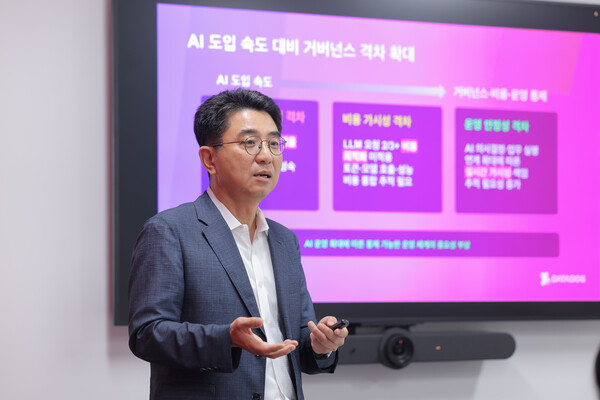
Eom Su-chang (엄수창), head of Datadog's Korea office, said companies' rapid adoption of AI is sharply increasing complexity. He said observability also needs an end-to-end solution. He stressed that while many companies do well in separate areas such as IT management, AI protection and cost management, there is no company that provides everything across the enterprise on a single platform like Datadog.
He added that demand for paid AI services inside companies is surging and operations are shifting from a single-model setup to a multi-model system. He said the more a company runs various models and agents at the same time, such as Claude, Copilot and Cursor, the more issues around cost, security and reliability emerge at once. He added that Datadog has a structure that can connect operational signals collected through observability with security and AI governance.
He also said the company will provide localized support so South Korean companies can establish operational stability and governance systems in line with the pace of AI adoption. He said Datadog Korea is currently working with more than 26 partners, including GS Neotek, MegazoneCloud and LG CNS, to support more than 1,000 domestic customers in finance, manufacturing, commerce and games.
According to the company, Datadog's integrated observability platform consists of three pillars: autonomous operations, AI governance visibility and security.
For autonomous operations, the focus is on a direction that goes beyond monitoring and observability to autonomy.
Monitoring is the stage of watching metrics such as CPU usage and error rates and sounding an alarm when an anomaly occurs. Observability is the stage of linking logs and various metrics to identify why a problem occurred. Autonomy goes a step further, meaning an environment that has evolved to a level of autonomous operations that diagnoses and fixes issues on its own.
To build autonomy, Datadog deployed Bits AI. Eom said Bits AI automatically detects when an error rate exceeds a threshold, forms hypotheses, verifies them one by one, and then presents the root cause and a code fix proposal. He said tasks that took engineers 50 minutes to 2 hours can be handled in 5 minutes. He said it also includes infrastructure automation that automatically adjusts memory and CPU resources according to guardrail criteria.
AI governance visibility consists of three parts: agent observability, cost management and linkage with business metrics.
Agent observability supports the ability to look into how AI agents work internally. Jeong Young-seok (정영석), technical lead at Datadog Korea, said that in a multi-agent structure, companies can see in real time which LLM each agent used, how long each stage took, and token usage and costs. He said cost management integrates and shows AI costs incurred across multiple accounts, such as Claude, Copilot and Cursor, on a single screen. He said it can track cost trends by team and model and determine whether to switch to an optimization model.
Linkage with business metrics supports distinguishing in real time whether an issue is an IT problem or a strategy problem by connecting operational data with actual business performance.
Security is one of Datadog's new business areas that it is fostering to expand the scope of observability, the company said. The company said it started security relatively late, but growth has been accelerating with aggressive investment over the past 5 years. Jeong said the AI Guard gateway inspects requests in real time to block malicious prompt injection, sensitive data leaks and policy-violating requests. He said if an injection is hidden in a receipt-processing agent that tells it to extract transaction data externally, it detects it and blocks the response itself.
 Hwang Chi-gyu
delight@d-today.co.kr
Hwang Chi-gyu
delight@d-today.co.kr