
In a comparison test in which four artificial intelligence coding models were given the same prompt to build an app, Grok 4.5 ranked first on speed and cost.
On July 9 local time, online media outlet Gigazine reported that AI company TryAI ran the same prompt once each on Grok 4.5, GPT-5.5, Claude Opus 4.8 and Claude Fable 5, then compared completeness, latency and cost.
Each model was instructed to build an interactive app as a single standalone HTML file without libraries or network calls. TryAI ran the outputs in an actual browser and recorded the results, without additional instructions or prompt changes.
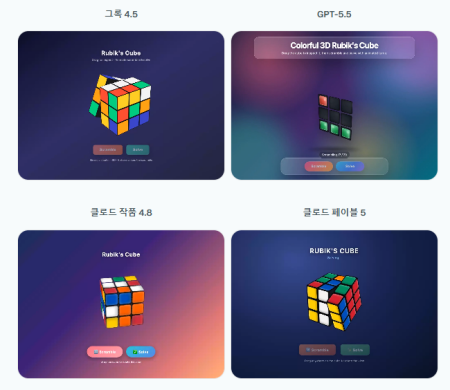
The tasks were a 3D Rubik’s Cube, a particle gravity sandbox and a block-breaking game. For the 3D Rubik’s Cube, presented as the most difficult task, Claude Opus 4.8 and Claude Fable 5 produced outputs that met the requirements in a single attempt. Both models implemented a 3D cube with rotation animation and automatic shuffle and solve functions at once. Grok 4.5 initially failed to render the cube and produced a result only on the second attempt. GPT-5.5 output a flat shape instead of a cube.
For the particle gravity sandbox, all four models produced functioning results. TryAI ranked GPT-5.5 first for this task. Grok 4.5 implemented a clean sandbox with an orderly structure, and Claude Opus 4.8 was assessed as having good physics 표현 but somewhat less visual appeal. Claude Fable 5 put more weight on smoothly glowing spherical 표현 than on particles.
For the block-breaking game, all four models produced results usable in practice. Grok 4.5 and GPT-5.5 implemented a neon-style arcade design, and GPT-5.5 also added a structure that builds points while bouncing the ball. Claude Opus 4.8 and Claude Fable 5 also met the task requirements.
In an additional test on SVG image generation, Claude Fable 5 received the highest evaluation. All four models could not create raster images such as JPEG or PNG, but they could generate SVG. Asked to produce a scene such as an astronaut walking on the moon’s surface riding a horse, Claude Fable 5 delivered the most complete result as a cartoon-style image. GPT-5.5 produced a somewhat distorted horse shape, and Grok 4.5 faithfully reflected the prompt’s intent. Claude Opus 4.8 matched the scene but had duplicate attributes in the SVG that caused rendering problems.
Grok 4.5 also stood out in cost and latency comparisons. TryAI ran three types of prompts — coding, reasoning and summarisation — three times each on every model and capped outputs at 400 tokens. Grok 4.5 took less than 0.5 seconds to produce the first token and recorded a processing speed of about 110 tokens per second. It was about twice as fast as the other models and had the lowest cost per response.
But the difference was not large when looking only at the median of total processing time. That was because Grok 4.5 responses were relatively long. Grok 4.5 had the most tokens per answer, and 5 percent of all measurements exceeded 9 seconds. GPT-5.5 was the most agile with short responses, and Claude Opus 4.8 sat at a middle point balancing speed and cost. Claude Fable 5 was the slowest and also had the highest cost.
The comparison shows the need to look at response speed and cost structures alongside the completeness of coding outputs. Grok 4.5 showed weakness on the most difficult task, but it confirmed clear strengths in processing speed and cost competitiveness.
 Yoonseo Lee
yslee@d-today.co.kr
Yoonseo Lee
yslee@d-today.co.kr