
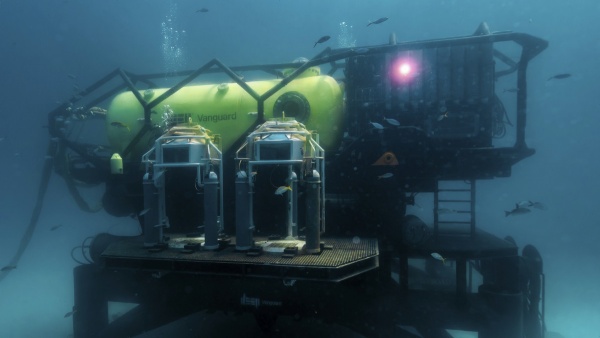
U.S. undersea habitat developer DEEP has installed the test habitat Vanguard on the seabed at a depth of 17 metres in the Florida Keys National Marine Sanctuary and begun its first trial run. Researchers will remain underwater for several days to conduct scientific surveys and test the feasibility of long-term stays.
On July 10 local time, online media outlet Gigazine reported that DEEP is deploying 4 test crew members into Vanguard to check the undersea living environment and operating systems. The mission is viewed as a first step toward building infrastructure for long-term undersea habitation.
Vanguard is designed for a range of uses including scientific research, environmental monitoring, specialist diver training and astronaut training. DEEP has outlined a long-term plan to build undersea habitats that can operate semi-permanently across continental shelves.
The first trial mission also includes Don Kanagis, DEEP's head of scientific research. He is a specialist who has studied human physiological responses in extreme environments, particularly changes in the brain and nervous system, and has previously participated in NASA's undersea habitat project mission NEEMO 21.
The main reason undersea habitats are drawing attention is the research environment. Organisms and samples collected in the deep sea can undergo sharp pressure changes during transfer to the surface, which can alter molecular and cellular characteristics.
Kanagis explained that analysing samples under the same pressure conditions as the seabed could allow researchers to study characteristics that were difficult to identify previously. He said it would also make possible a new research method of analysing deep-sea samples almost in real time.
The structure resembles a large decompression chamber. Crew members arrive using a small submersible and enter the facility while maintaining the same pressure as the surrounding water. The interior is then slowly decompressed to create an environment suitable for long stays. The approach applies the same principle as saturation diving.
Once decompression is complete, crew members can exit to the sea through a 'moon pool' at the bottom of the facility to work. It is designed to allow seabed activity for many hours, far longer than ordinary scuba diving, while connected to an air supply system and life-support cables.
The operating system links the surface and the seabed. Equipment installed on a surface buoy supplies power and air to the facility and maintains 24-hour contact with an onshore base through satellite communications. The facility is also equipped with a freshwater supply system.
DEEP is not limiting its use to scientific research. The company is also considering expanding into various industrial fields including support for oil and gas offshore plants, the defence industry and underwater leisure. Related industry companies are also known to be participating in the project.
DEEP has also outlined plans to expand the undersea living experience beyond researchers to the general public over the long term. Kanagis said artists, historians, students and educators, as well as politicians, should also consider living underwater. He stressed that directly experiencing the environment below the sea would help improve understanding of marine ecosystems.
The trial run is a first step to test whether undersea habitats can be used in real research and industrial settings. DEEP plans to confirm whether Vanguard can reliably support long stays and continuous undersea missions, then accelerate development of next-generation undersea habitat infrastructure.
 Jinju Hong
hongjj@d-today.co.kr
Jinju Hong
hongjj@d-today.co.kr