
South Korea's financial authorities have begun reviewing ways to improve rules for single-stock leveraged exchange-traded funds (ETFs), which have been cited as one factor behind a recent rise in KOSPI volatility. Raising basic margin deposits, strengthening mandatory education and restricting new listings are reportedly under review.
The financial investment industry said on July 10 that regulators are considering raising the basic margin deposit for leveraged ETFs to 30 million to 50 million won from the current level of about 10 million won.
Mandatory pre-trade education could also be significantly strengthened. Current training totals about 2 hours, with 1 hour of general instruction and 1 hour of advanced instruction, but proposals have been raised to increase it to 30 hours and require simulated trading and passing an exam.
Limiting additional new listings of single-stock derivatives ETFs is also under discussion. Regulators are also reviewing ways to manage more strictly how liquidity providers (LPs) submit quotes and how tracking error rates are controlled.
Restrictions on investing through inactive accounts have also been raised. The aim is seen as broadly raising barriers to entry to cool overheated investor sentiment.
The measures are being described as similar to regulators' response during the earlier equity-linked warrant (ELW) episode. At the time, authorities reduced market overheating not by scrapping the products, but by introducing a basic margin deposit, restricting dedicated lines for ultra-high-frequency traders and monitoring unusual trading.
The controversy over single-stock leveraged ETFs has spread as KOSPI volatility has sharply increased. The Korea Exchange said the KOSPI's average daily intraday fluctuation rate widened to 5.04 percent in June from 3.79 percent in March, and to 7.22 percent for July 1 to 9.
The KOSPI 200 volatility index (VKOSPI) also jumped to an average of 87.18 in July from 62.51 in March. Average daily turnover rose about 67 percent to 50.35 trillion won in June from 30.14 trillion won in March.
Some in the market say it is difficult to view single-stock leveraged ETFs alone as the cause of increased volatility. They say macroeconomic uncertainty also played a role, including concentration in global semiconductor stocks, foreign selling and worries about U.S. policy rate hikes.
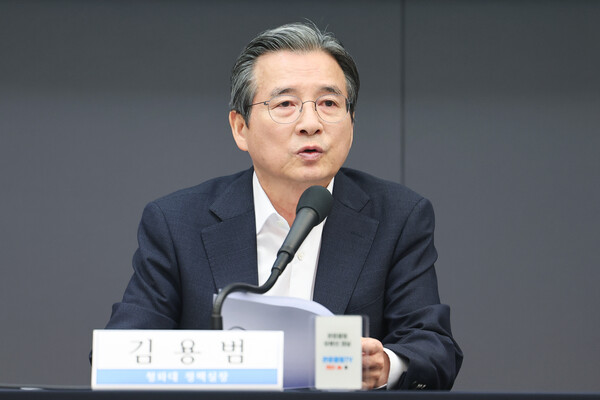
The presidential office also left open the possibility of strengthening related rules. Kim Yong-bum (김용범), senior presidential secretary for policy, said at a briefing that, regarding single-stock leveraged ETFs, "Since this is a system that was introduced for the first time, if supplementary measures are needed, I think a decision will likely be made at the market conditions review meeting."
Kim said he is reviewing market conditions at a market conditions review meeting attended by the Ministry of Finance and Economy, the Financial Services Commission, the Bank of Korea and the Financial Supervisory Service. He added they plan to closely examine what impact the system's operation has on the market.
The financial investment industry shares the view that investor protection measures need to be strengthened, but it has also raised concerns that delisting or excessive trading restrictions could increase market turmoil. It also says scrutiny should cover not only single-stock leveraged ETFs but also semiconductor concentration, margin trading, derivatives and passive fund flows.
 Sangyeop Oh
yub@d-today.co.kr
Sangyeop Oh
yub@d-today.co.kr