
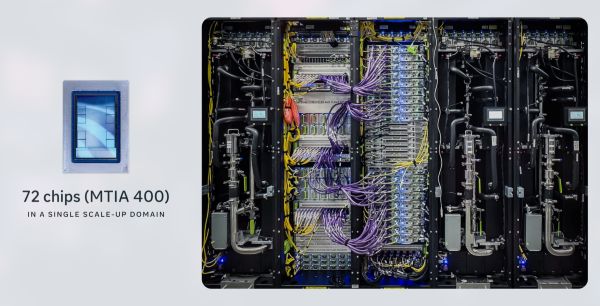
Meta plans to start mass production of the latest version of its in-house artificial intelligence (AI) chip from September.
On July 9 (local time), IT media outlet TechCrunch reported that Reuters, citing internal documents, said Meta is bringing forward its AI chip production schedule to lower graphics processing unit (GPU) costs amid an unprecedented parts shortage. The documents said at least 1 chip passed the testing stage in about 6 weeks.
Meta is designing the chip with Broadcom and plans to have it manufactured by TSMC. The structure also shows it will source memory from Samsung Electronics, storage from SanDisk and fibre-optic equipment from Sumitomo Electric. This means it is building a broad supply chain covering not only chip production but also surrounding components and data centre equipment.
The chip belongs to a product family developed under Meta's in-house AI chip programme MTIA (Meta Training and Inference Accelerator). Meta unveiled 4 new MTIA-based chips in March, and some of them have already been deployed or are set to be introduced sequentially this year and next year. As AI evolves rapidly, Meta expects requirements to change by the time the chip enters actual production, so it chose a modular design approach. Meta explained at the time, "Each MTIA generation builds on the previous generation, uses modular chiplets, incorporates the latest AI workload insights and hardware technologies, and is deployed on a shorter cadence."
The expansion of its in-house chips aligns with a strategy to reduce the burden of purchasing GPUs from Nvidia and AMD. Even if Meta reduces external chip purchases, spending on the 2 companies will not fall sharply. Meta plans to use the chips for training recommendation and ranking algorithms, broad AI workloads and inference tasks for its applications, and it has been making in-house AI chips since 2023.
Meta is pouring huge funds into expanding AI infrastructure. In April, the company expected its capital expenditures this year to reach $125 billion (about 190 trillion won) to $145 billion (about 220 trillion won), with a large portion allocated to AI-related investment.
Meta has been investing billions of dollars as it expands data centre and power contracts worldwide to train and deploy its new AI model series Muse Spark. It plans to deploy 7 gigawatts (GW) of computing resources this year and double that next year.
Meta last year signed a deal with Arm to secure computing for recommendation systems. It has also signed a multibillion-dollar deal to adopt AMD's Instinct GPUs and a multibillion-dollar deal to use Amazon's in-house central processing units (CPUs) for AI purposes.
Efforts to spread funding flows concentrated on Nvidia are not limited to Meta. OpenAI last month unveiled an inference processor it is developing with Broadcom. Anthropic is also reported to be considering developing its own chip with Samsung Electronics. Amazon and Google are also developing chips for AI training and inference, and many startups have entered the market.
 Seung-ah Yoo
ysah@d-today.co.kr
Seung-ah Yoo
ysah@d-today.co.kr