
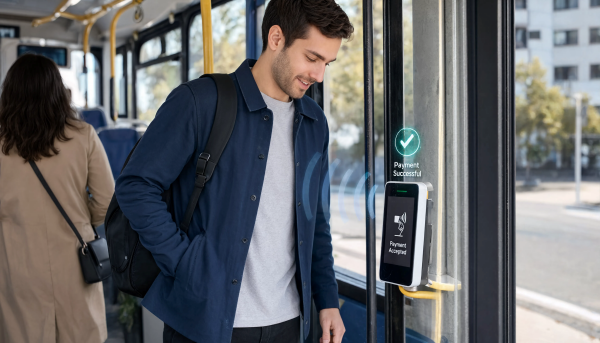
Japan's JCB, Resona Holdings and Odawara Device are moving to introduce an ultra-wideband (UWB)-based payment service that lets passengers pay bus fares without taking out their smartphones.
Japan's ITmedia reported on July 9 that the three companies signed a memorandum of understanding to commercialise a UWB-based bus payment service and will jointly develop and run trials, aiming for commercial rollout in 2028. Technology verification will begin in 2026. The companies plan a small-scale commercial service on some routes in 2027.
The core of the project is “hands-free payment.” Users can pay fares automatically when boarding and getting off, even with a smartphone kept in a pocket or bag. They do not need to tap a phone on a device or show a screen, as with NFC transit cards or QR codes.
The technology is based on UWB, or Ultra Wideband. UWB is a short-range wireless technology that can measure location accurately down to a few centimetres, and its use is expanding as it is increasingly built into smartphones. Payment terminals can precisely recognise a user's location and process fares automatically, and the approach is seen as a step beyond existing contactless payments.
The collaboration extends UWB payment business cooperation that JCB and the Resona Group signed in March. At the time, the two companies said they would pursue commercialisation centred on in-store payment services, and this time expanded it to public transportation. Odawara Device, which has a high market share in Japan's route bus fare collection system field, joined the project, raising the possibility of deployment in the field.
The decision to start with buses reflects labour shortages in the public transportation industry. Japan's bus industry faces worsening driver shortages and ageing, and handling multiple payment methods and guiding passengers has become a burden on drivers. Criticism has persisted that longer payment processes, especially during commuting hours, can lengthen boarding times and affect on-time operations.
With UWB-based payments, users can pay automatically without additional actions. Bus operators expect an environment in which drivers can focus on driving rather than responding to payments. The companies also expect to provide personalised services such as discount coupons and route guidance using boarding history.
Standardisation work will also proceed. Odawara Device plans to join the FiRa Consortium, an international UWB standardisation body, and move to develop standards linking bus fare systems with UWB technology.
A key point to watch is the results of trials and the scope of on-site deployment. The three companies presented a schedule for small-scale commercialisation in fiscal 2027 and full-scale practical use in fiscal 2028, but service-stage deployment will also need to verify terminal integration, recognition accuracy along boarding and alighting routes, and user guidance systems.
If trials proceed as planned, public transportation payments in Japan are expected to move beyond existing “contactless” and take a step toward an era of “zero-touch” payments that do not even require touching a terminal.
 Jinju Hong
hongjj@d-today.co.kr
Jinju Hong
hongjj@d-today.co.kr