
An analysis said pressure on banks' profitability and soundness could diverge depending on interest rates, the economy and stock-price trends. It said balance is important across profitability, growth and soundness rather than any scenario working uniformly for or against banks.
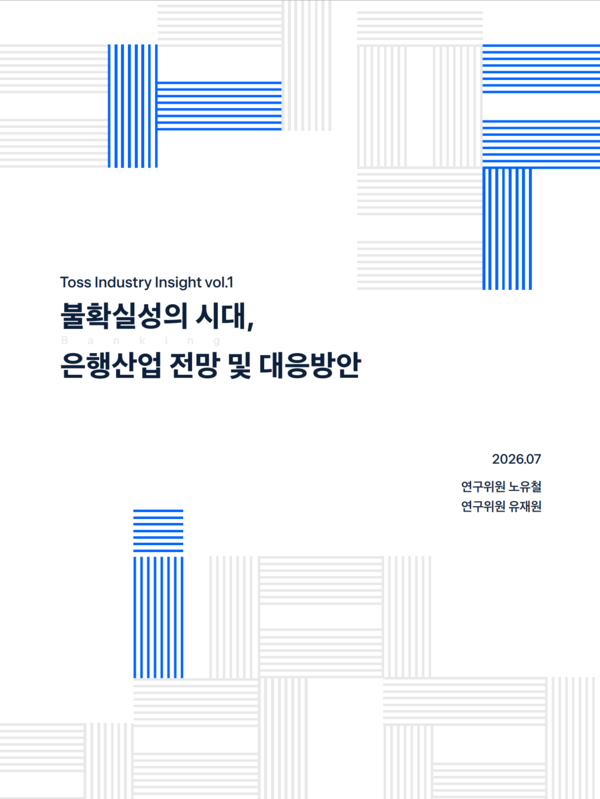
Toss Insight, a financial management research institute under Viva Republica, the operator of Toss, said on Thursday it published a report titled "In an Age of Uncertainty, Banking Industry Outlook and Response Measures".
The report analysed eight key variables for the second half of 2026 through 2027, including interest rates, economic growth, inflation, the exchange rate, household loans, corporate loans, stock prices and housing prices. Based on that, it set three scenarios - baseline, optimistic and pessimistic - and estimated banks' profitability, soundness and growth indicators for each scenario.
Toss Insight also used probability distributions to check how far bank management indicators could worsen if conditions deteriorate sharply, not just the average outlook. It reviewed the need for responses by the banking sector by factoring in so-called tail risks.
The analysis found none of the three scenarios was uniformly favourable or unfavourable for banks. If interest rates rise and the economy expands, that can support interest income and loan growth, but borrowers' repayment burdens could rise and delinquency and credit-risk may also increase. If interest rates fall and the economy slows, borrowers' repayment burdens may ease somewhat, but banks' profitability and growth foundations could weaken.
The report recommended that banks adjust capital and provisioning strategies based on scenario-by-scenario sensitivities rather than relying on a single outlook.
It said banks should check how the balance among profitability, growth and soundness changes as variables shift rather than prejudging the business environment in a particular direction.
Internet-only banks were analysed as a segment where these trade-offs appear more clearly.
It also said the combination of a household-loan-focused business structure and the regulatory environment could limit loan-growth capacity even during an expansion phase.
The report said that in the second half of this year, a variable banks should watch includes the possibility that a stock-market boom could slow deposit inflows.
According to Toss Insight's analysis, when the KOSPI monthly return rises by 1 percentage point, term-deposit inflows slow for up to the next three months. Based on balances as of February 2026, it has the effect of reducing term-deposit inflows by about 600 billion won to 930 billion won.
The report said banks need to fine-tune funding strategies by distinguishing between funds with a high likelihood of outflow and funds likely to be maintained over the long term, rather than focusing only on managing total deposit balances.
Toss Insight researchers said, "As uncertainty grows, a bank's success or failure depends not on how quickly it grows, but on what risks it chooses to bear and whether it has the strength to withstand them." They added, "We hope the report helps banks check the balance between risk and returns."
 Ji-young Lee
ljy@d-today.co.kr
Ji-young Lee
ljy@d-today.co.kr