
Post offices and internet-only banks are beginning to fill the void left by the disappearance of bank branches. By allowing older people and local small merchants to access loans through nearby counters or non-face-to-face apps, an inclusive finance experiment aimed at shoring up regional financial gaps is moving into full swing.
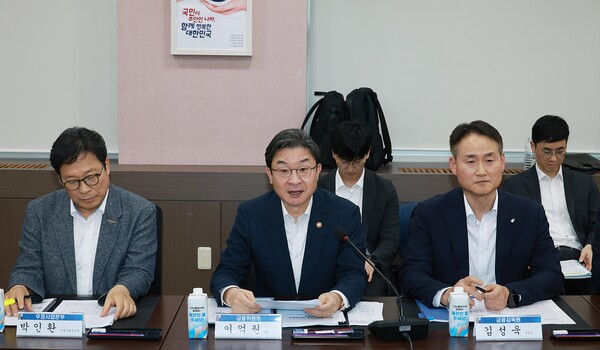
The Financial Services Commission on July 9 held the sixth meeting on an inclusive finance transformation and a regional finance briefing at the Jeonbuk Regional Small and Medium Business Administration and announced community-based financial policies to improve access to finance in regional areas.
The main measures include post offices acting as bank agents, joint loans between regional banks and internet banks, and mutual aid insurance linked to local governments. In areas with fewer bank branches, post offices will serve as offline financial touchpoints. Loans for small and medium-sized firms and small merchants will be provided by combining regional banks' local credit screening capabilities with internet banks' non-face-to-face channels. Gaps in coverage for vulnerable groups will be addressed through an insurance industry mutual aid fund and cooperation with local governments.
◆ Post offices to serve as 'offline loan comparison counters'
A pilot project for post offices acting as bank agents will begin on July 20 at 20 general post offices nationwide. The pilot will target areas with low access to bank branches, including Goseong, Changnyeong and Hadong; Cheongyang, Taean, Danyang and Goesan; Gurye, Damyang, Yeonggwang and Hampyeong; Bonghwa, Cheongdo and Seongju; Imsil, Sunchang and Gochang; and Pyeongchang, Hwacheon and Hoengseong.
Under the bank agency programme, residents can visit a nearby post office to consult on and apply for major banks' loan products, compare screening results by bank, and proceed through to signing the loan agreement.
If a customer applies for a loan consultation at a post office, the bank conducts screening and sets the interest rate and limit. The customer compares terms at the post office and signs the agreement. The bank then completes final approval procedures and deposits the loan funds.
Products offered include personal credit loans from the four major banks — KB Kookmin Bank, Shinhan Bank, Woori Bank and Hana Bank — and Saehui-mang Holssi, a policy loan product for low-income borrowers.
A total of 8 products will be covered: 1 personal credit loan from each bank and 1 Saehui-mang Holssi product from each. During the pilot phase, the programme will handle unsecured household credit loans first. Limits for general credit loans range by product up to 50 million won to 100 million won, and Saehui-mang Holssi will be offered up to a limit of 35 million won.
Banks will also provide preferential benefits for customers using the bank agency programme. KB Kookmin, Woori and Hana will apply an additional preferential rate of 0.2 percentage points. Shinhan will waive early repayment fees on personal credit loans.
To help the programme take hold, each pilot post office will have designated staff, and bank employees will also be seconded for 1 to 2 weeks after the start of the project.
◆ Joint loans by regional and internet banks also planned
Joint loans targeting regional small and medium-sized firms and sole proprietors are also being pursued.
The 'regional bank-internet bank joint loan' model recruits customers through an internet bank app, while regional banks and internet banks share responsibilities for screening and funding.
Borrowers apply through an internet bank's non-face-to-face channel. The two banks jointly decide the loan limit and interest rate based on corporate and credit information and non-quantitative information. Once a loan is finally approved, the regional bank and the internet bank split the funding and execute the loan in set proportions.
Financial authorities see the structure as likely to improve access to finance for regional SMEs and small merchants while reducing interest-rate burdens. That is because internet banks can use lower funding costs than regional banks and digital platforms, while regional banks can use capabilities in locally based corporate finance screening and post-loan management.
Joint loans are seen as meaningful in terms of diversifying regional banks' sales channels and expanding internet banks' productive finance. Regional banks can broaden customer touchpoints through internet bank platforms, while internet banks can expand their loan portfolios, which have so far centred on household lending, into SMEs and sole proprietors.
The FSC plans to review within July whether to designate the programme as an innovative financial service and, after systems development, support the launch of joint loan products within 2027.
◆ Mutual aid insurance to strengthen safety net for vulnerable groups
The insurance industry's mutual aid insurance will also be expanded as one pillar of the regional financial safety net. The programme uses a 30 billion won mutual aid fund from the insurance industry to provide free customised insurance to vulnerable groups within local governments.
In September last year, the insurance industry signed its first memorandum of understanding with North Jeolla Province for the mutual aid insurance programme. It will provide comprehensive insurance for small merchants, including injury and fire insurance, free of charge in North Jeolla next month. It will later expand free insurance coverage to 7 local governments, starting with North Jeolla.
Mutual aid insurance will also be broadened to support vulnerable older people such as those living alone and to address coverage gaps from climate and technological changes. For older people living alone, it will offer a package combining injury insurance and healthcare services, supporting treatment and recovery costs for fall accidents, health consultations and medication guidance. In climate-related areas, insurance linked to heat waves, heavy rain and cold snaps will be considered. In technology-related areas, insurance to compensate victims of electronic financial fraud such as voice phishing and messenger phishing is also under review.
The FSC plans to pursue memorandums of understanding between the insurance industry and local governments, public institutions and policy finance institutions where consultations have been completed, and to launch revamped insurance products in the first quarter of 2027.
◆ Regional banks ask for regulatory easing for inclusive finance
On the ground in regional finance, calls were also raised for expanding the bank agency programme and for tailored financial support.
Regional banks proposed easing regulatory burdens on loans with an inclusive finance character, such as policy loans for low-income borrowers and refinancing loans for small merchants. They said increasing such lending could raise the burden of managing loan-to-deposit ratios and capital ratios.
If inclusive finance loans are reflected in bank soundness indicators in a way similar to general loans, it could constrain expanded regional credit supply. This is seen as why they requested policy supplements such as changes to how loan-to-deposit ratios are calculated or adjustments to risk weightings.
A financial industry official said, "Even if regional banks want to provide financial support to actively help local small merchants, they can have their hands tied if existing bank soundness regulations are applied as they are." The official added, "They asked for reduced burdens for loans with public-interest purposes."
The FSC said it will review requests raised in the field together with relevant institutions such as local governments, the Postal Service and the Financial Supervisory Service, and support the stable establishment of a community-based inclusive finance model.
FSC Chairman Lee Eok-won (이억원) said, "The government has been building an institutional foundation, including expanding local funding supply by policy finance institutions, and rationalising regulations and 마련해 왔다" for preferential local finance by the private financial sector and preparing incentives. He added, "We will 추진할 것 생활 밀착형 financial policies that local residents and SMEs and small merchants can directly feel in everyday life."
 Lee Ji-young
ljy@d-today.co.kr
Lee Ji-young
ljy@d-today.co.kr