
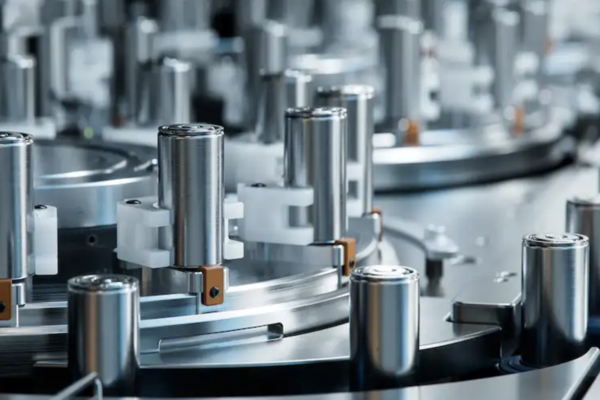
The battery industry is following the semiconductor division of labour. It is rapidly being reshaped into a structure in which Western countries that hold the technology handle design, while Asia, with manufacturing infrastructure, takes charge of mass production. Just as semiconductors split into design (fabless) and manufacturing (foundry) and fostered specialist contract manufacturers, a 'foundry' model dedicated only to production is emerging as a new market in batteries as well.
As of July 10, industry officials say Western companies in the battery industry are focusing on next-generation chemical composition design and securing intellectual property, while Asia, with manufacturing infrastructure and skilled processes, is increasingly taking on contract production.
This division of roles is the result of matching needs on both sides. Companies specialising in design can enter the market without building factories, while manufacturers can raise utilisation rates by filling secured lines with orders from multiple customers. As in semiconductors, where fabless companies compete on design and foundries cut costs through economies of scale, batteries are also settling into a structure in which design and manufacturing each focus on what they do best.
This reorganisation began as Western manufacturing competitiveness weakened. According to a report on the state of European battery technology by the European Union's Joint Research Centre, the EU was assessed as having failed to secure an independent manufacturing advantage comparable to Asia across the battery research and manufacturing supply chain due to limits in raw material supply and high energy and labour costs. The United States is not in a different situation. A report by the Center for Strategic and International Studies was reported to have pointed out that battery cell localisation in the United States is under way, but full decoupling from China's and Asia's ecosystem is impossible.
A direct trigger accelerating the division of labour is the limits of building in-house plants. The model of directly building and operating large-scale gigafactories has repeatedly been held back in securing yields due to massive capital and permitting burdens and difficulties in securing skilled workers. Sweden's Northvolt bankruptcy is cited as a case that clearly showed these limits. Since then, an asset-light strategy has spread across the industry: owning only core materials and design technologies while outsourcing manufacturing rather than bearing fixed costs. The calculation is that borrowing Asia's already proven mass-production infrastructure can shorten plant construction time and save production costs.
The U.S. regulatory environment has also played a role. Industry officials explain that as the National Defense Authorization Act and the Inflation Reduction Act strongly require the exclusion of batteries tied to supply chains of foreign entities of concern, including China, U.S. companies are seeking a workaround by using idle facilities of non-Chinese Asian manufacturers, such as in South Korea and Southeast Asia, in a foundry format rather than directly using factories in China.
The growing diversity of battery materials and technologies is also accelerating the division of labour. As various chemistries have emerged from the existing structure centred on nickel-cobalt-manganese, including lithium iron phosphate, lithium manganese-rich, and sodium-ion, it has become difficult for one company to directly produce every product.
A trend is emerging in which companies internalise their main products while using outsourced production for new materials or non-core technologies. Even large battery companies seeking to speed up development are reported to be using foundries at the development stage. That is increasing demand for contract manufacturing in areas such as robot batteries and materials including sodium and lithium manganese-rich.
◆"Market formation hinges on profitability and yield stabilisation"
Electrification is spreading beyond electric vehicles and energy storage systems to robots, mining, agricultural machinery and construction equipment, increasing demand for many product types in small volumes. Because small, customised volumes are less economical for large manufacturers to run directly on their lines, the view is that it is more efficient to leave them to specialist contractors. A prolonged electric vehicle chasm, or demand slowdown, has also increased idle facilities, aligning interests with contract manufacturing demand.
This trend is also confirmed through cooperation between South Korean companies and Europe. South Korean electrode foundry company JR Energy Solution signed a memorandum of understanding with Norwegian battery company Morrow Batteries at 'InterBattery 2026' to build a European supply chain. The plan combines JR Energy Solution's electrode foundry capabilities with Morrow's manufacturing infrastructure and its lithium iron phosphate and lithium nickel manganese oxide cell technology, using a Norwegian plant as a European manufacturing hub. It is the result of aligned interests between a European manufacturer that faced challenges improving yield and utilisation and a South Korean company with contract manufacturing experience. JR Energy Solution estimated in a seminar that the battery foundry market would form at a scale of at least 30 trillion won.
The spread of the foundry model depends on the actual pace at which contract volumes expand. If demand for many product types in small volumes grows as forecast and large battery companies' use of outsourced production at the development stage becomes routine, business opportunities for foundry companies handling downstream processes such as electrode and cell assembly are expected to broaden. An industry official said, "Profitability in contract production and stabilisation of yields must be supported."
 Dae-geon Seok
d2dg@d-today.co.kr
Dae-geon Seok
d2dg@d-today.co.kr