
OpenAI and Anthropic, which have set up offices in South Korea and stepped up their push into the domestic market, are also moving faster to expand their foothold in the startup ecosystem.
There is a reason. The companies say Korean startups are creating many innovative business cases using their AI models, and that feedback from Korean startups plays a meaningful role in improving the models.
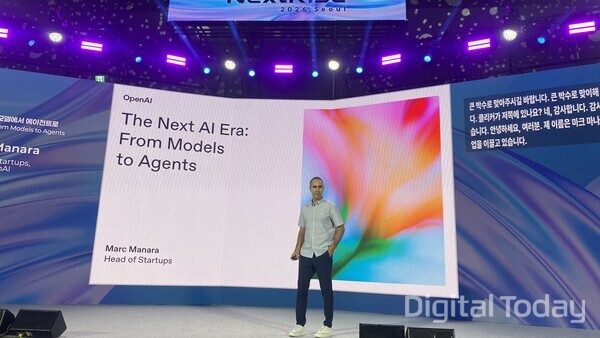
The two companies attended NextRise Seoul 2026, held by Korea Development Bank and the Korea International Trade Association on June 18 and 19 at COEX, stressing the importance of startups and their willingness to provide active support. Mark Manara (마크 마나라), OpenAI’s head of startups, and Yeop Lee (이엽), Anthropic’s Asia-Pacific startup partnerships lead, spoke at the event.
◆OpenAI puts more weight on technical advice; separate support via Korean VC partners
On startup support, OpenAI highlighted technical advice on the use of its models. Manara said small changes to prompts, harness design or the way tools are defined can significantly change evaluation results.
Support for Korean startups comes in three main tracks. The first is access to frontier models. Manara said most startups want to use the latest models, adding that working with OpenAI has the advantage of staying on that cutting edge.
The second is support for early-stage Korean startups. It provides application programming interface credits, higher usage limits and advice from technical teams in cooperation with domestic venture capital partners. It also runs an applied AI specialist team for all startups, working directly with them to help use OpenAI technologies such as Codex.
The third is building a domestic community. On June 15, OpenAI gathered Korean founders for a Founder Day. It also held breakout sessions by topic, including voice technology and Codex.
What OpenAI gains from supporting startups is feedback needed to improve its products. Manara said startups are among the first customers to use frontier models and are the first to flag performance gaps and needed use cases. He said when the research team releases a new model, startups use it and provide feedback, which then feeds back into research.
He cited U.S. accounting automation startup Basis as an example. Basis provided detailed feedback while using the code interpreter function in the OpenAI API, and OpenAI reflected that feedback to improve the function quickly. Basis later also participated as a design partner, receiving early access to new OpenAI features such as computer use and providing feedback.
He also shared know-how on building AI agents for startups. He stressed that the harness is the product, and that designing the context, tools and agentic loop around the model is key to turning model performance into real product competitiveness.
He also said agents need clear goals. He said if goals, success criteria and termination conditions are provided together, an agent can self-check, correct errors and move toward the goal. He cited Codex features such as slash goal and goal mode as examples.
On multi-agent approaches that run several agents at the same time, he advised building a single agent properly first and then increasing complexity. As another tip, he said planning should be done with the model from the start. He said when a plan is made with the model based on a goal, the agent follows the plan much better during execution.
◆Anthropic stresses shared philosophy; runs Claude for Startups
At the event, Lee shared his impressions from covering the Asia-Pacific region, including South Korea, Japan, Taiwan, Singapore, India and Australia.
He said the Asia-Pacific region is where the most innovative use cases emerge. In South Korea, he said it is notable that Claude is also widely used for physical AI.
Lee said that while AI-enabled B2B software was mainly built in the past, it is now trending toward combining with physical AI.
Lee said Anthropic’s view of startups differs from that of typical investors. He said rather than assessing whether the companies it focuses on have good or bad growth prospects, it concentrates on what help is needed, and supports startups doing well from an ecosystem perspective.
On what Anthropic gains from supporting startups, he said there are business advantages such as token usage, but he stressed that in the long term the focus is on the ecosystem. He said the goal is for many such startups to emerge and benefit the world after artificial general intelligence, adding that Anthropic being a public benefit corporation is in the same context. He added that it looks at how much startup support helps that goal.
He also offered advice to founders. He said as barriers to product development fall, it is common for startups to build first without setting a go-to-market strategy, fail to see the results they expected and return to the development stage. He said successful AI-native builders actually focus deeply on go-to-market and distribution rather than product development.
He said there are also enterprise sales opportunities. He said enterprises have traditionally been very cautious and passive in adopting AI due to security and regulatory issues, but that thanks to companies like Anthropic, the pace of signing contracts for AI solutions has quickened. He said the ability to connect preferences and judgement has become more important than ever.
As a support program, it runs Claude for Startups. If a startup enters information on the website, it can receive credits, a connection to a dedicated manager and applied AI technical resources.
 Seul-gi Son
sageson@d-today.co.kr
Seul-gi Son
sageson@d-today.co.kr