
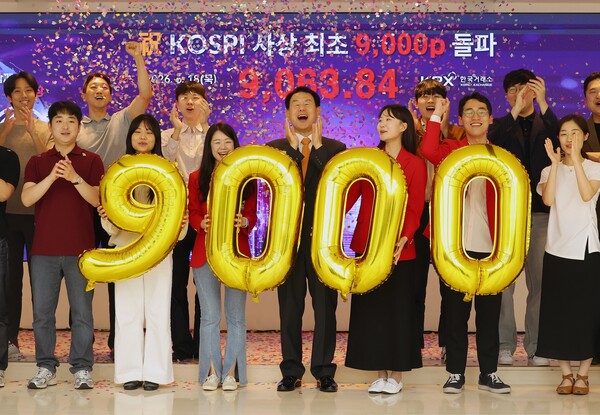
South Korean stocks are expected to look for direction this week as investors assess the U.S. May personal consumption expenditures (PCE) price index and Micron’s earnings release. The KOSPI has moved above the 9,000 level, but short-term volatility has also increased as concentration in semiconductors and IT hardware has strengthened.
Domestic shares last week showed a clear divergence between the KOSPI and the Kosdaq. The KOSPI rose 11.6 percent on the week, while the Kosdaq fell 2.7 percent.
Concentration in semiconductors also intensified. The KOSPI’s operating profit forecasts for 2026 and 2027 rose to 929 trillion won and 1,205 trillion won, respectively, helped by improving earnings momentum in semiconductors. The KOSPI’s 12-month forward price-to-earnings ratio is still low at around 8.5 times.
Excluding Samsung Electronics and SK Hynix, however, it rises to about 10.9 times. The index as a whole may look undervalued, but it means semiconductor earnings are lowering the valuation burden.
Retail investors’ funds continue to flow into the stock market. Net purchases by retail investors of domestic equity exchange-traded funds (ETFs) totaled 4.5 trillion won in June so far.
That compares with total net purchases of 6.4 trillion won in May, indicating the money move via ETFs is continuing. An expansion of leveraged ETFs is cited as a factor that increases stock price volatility.
Volatility is already high. The VKOSPI, the KOSPI 200 volatility index, recorded 90 points in June, above its peak during the global financial crisis.
The number of domestic stock-related ETFs rose to 615 at the end of May from 536 in January 2025, and leveraged ETFs also expanded to 43, up 14 from the previous month in May. As funds pile into specific industries and sectors, volatility in individual stocks and themes becomes larger than the index.
The first test this week is the U.S. May PCE price index. The U.S. May PCE, due on the 25th, is expected to rise 4.1 percent year-on-year, while core PCE is expected to climb 3.4 percent. That would be higher than the previous month.
As it is the first major inflation indicator to be confirmed since the June meeting of the Federal Open Market Committee (FOMC), the outcome could raise uncertainty over the Federal Reserve’s monetary policy again.
If inflation comes in higher than expected, concerns about further rate hikes could resurface. The policy rate was left unchanged at the June FOMC, but the dot plot was interpreted as hawkish. Markets are increasingly likely to react more sensitively to actual economic data than to Fed comments going forward.
If PCE matches forecasts or comes in below them, expectations for easing inflation could revive in tandem with a fall in oil prices. Oil prices fell to around $70 a barrel after a ceasefire agreement between the United States and Iran.
If oil price stability leads to easing inflation pressures, bond yields and the dollar could stabilise, which could also be favourable for South Korean stocks.
Micron’s earnings release is also an important variable. Micron is set to announce results for the third quarter of fiscal 2026 on the 24th. With an expected prolonged supply-demand imbalance in memory semiconductors, Micron’s results and guidance could affect investment sentiment for Samsung Electronics and SK Hynix as well.
The medium-term direction of the domestic stock market still depends on earnings. As the pre-earnings season for the second quarter begins, investors are expected to check whether earnings forecasts will be revised upward, led by Samsung Electronics. Existing leading sectors such as semiconductors, autos, shipbuilding, secondary batteries and defence are not facing a heavy valuation burden, and expectations for earnings improvement in 2026 are being maintained.
Ultimately, the key for the stock market next week is whether PCE increases interest rate 부담 and whether Micron’s results add fuel to the semiconductor rally. If inflation and rate burdens rise and expectations for semiconductor earnings falter, the possibility of a short-term adjustment is also open.
Lee Kyung-min (이경민), a researcher at Daishin Securities, said, "Short-term swings depending on the May PCE result and Micron earnings result should be taken into account, but the KOSPI’s uptrend is expected to continue and strengthen," adding, "If volatility expands further, a strategy of increasing exposure is effective."
 Oh Sang-yup
yub@d-today.co.kr
Oh Sang-yup
yub@d-today.co.kr