
The government will invest 7.54 trillion won to commercialise 229 artificial intelligence (AI) products and services to address labour shortages in farming, livestock and fisheries and to tackle safety accidents at industrial sites.
The government on Thursday announced the selection results for the "AI application product rapid commercialisation support programme (AX Sprint)". AX Sprint aims to speed the commercial rollout of finished products and services in a short period to promote AI transformation across daily life and industry.
The Office of Planning and Budget oversees the programme, with 11 ministries participating, including the Ministry of Trade, Industry and Energy, the Ministry of Science and ICT, the Defence Ministry and the Ministry of Agriculture, Food and Rural Affairs. The call drew 1,604 submissions for 246 projects. The government first selected 229 products and services.
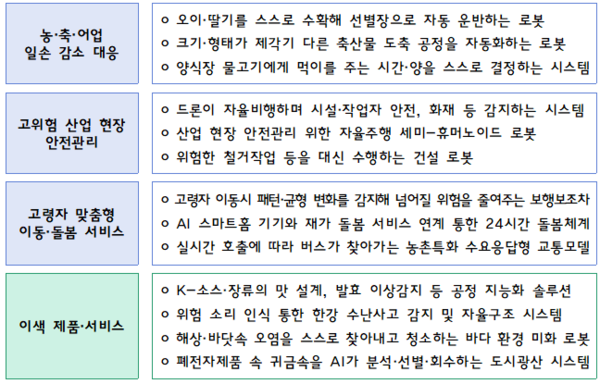
The selected products focus on timely areas such as labour, caregiving and safety. In farming, livestock and fisheries, the picks include robots that automatically harvest cucumbers and strawberries and transport them to sorting centres, and robots that automate slaughter processes for livestock products with inconsistent sizes and shapes. At fish farms, a system that analyses fish conditions and the environment and decides feeding times and amounts on its own will make up for labour shortages.
Selected products and services for older people include a walking-assist vehicle that detects walking patterns to reduce the risk of falls, a 24-hour care system linking smart homes with at-home care, and an on-demand rural demand-responsive transport model. At industrial sites, drones that autonomously fly to check facilities, worker safety and fire risks, and semi-humanoid robots that patrol sites, will prevent serious accidents in advance. Construction robots that carry out dangerous demolition work in place of people were also included as support targets.
Many products and services to address blind spots in daily life were also included. A manufacturing-intelligence solution to design the taste and flavour of K-sauces and fermented pastes and detect fermentation abnormalities was selected for support. The list also includes an autonomous rescue system that detects distress sounds on the Han River and directs the dispatch of life-saving equipment and drones, an environmental-cleaning robot that autonomously detects and cleans underwater pollution, and an urban-mine resource recovery system in which AI analyses valuable metals in discarded electronic products and robots sort and recover them.
Of the 229 selected projects, 209, or 91.3 percent, formed consortia with demand companies that will introduce or use the actual products. This is so demand companies can verify required functions and performance from the development stage and apply the products immediately to production lines and industrial sites after completion.
Among the selected companies, 188 were small and medium-sized firms, accounting for 82.1 percent of the total. Companies founded within 7 years numbered 59, and companies based outside the Seoul metropolitan area numbered 98, accounting for 25.8 percent and 42.8 percent, respectively. Projects applying domestic AI models accounted for 41.3 percent, while those adopting domestic AI semiconductors, neural processing units (NPUs), accounted for 30.6 percent.
The government will also provide regulatory, procurement and sales-channel support to help the selected products take root in the market. During the agreement-signing process, it will review regulatory difficulties by company and, if needed, link them to a regulatory sandbox. It will support outstanding products with innovative public procurement and participation in overseas exhibitions.
Park Hong-geun (박홍근), minister of the Office of Planning and Budget, said AX Sprint is a field-oriented fiscal programme that speeds commercialisation of AI products and services that can be used immediately in markets and on sites. He said relevant ministries would provide support through to the end, including on regulation, procurement and sales channels, so selected companies can deliver outcomes the public can feel within 1 to 2 years.
 Jin-ho Lee
jhlee26@d-today.co.kr
Jin-ho Lee
jhlee26@d-today.co.kr