
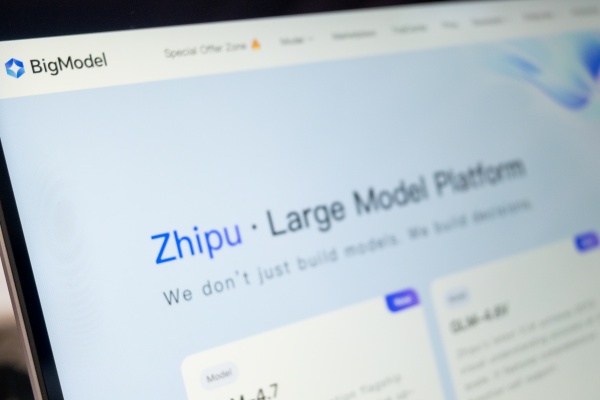
[DigitalToday reporter Jinju Hong (홍진주)] Chinese artificial intelligence (AI) company Z.ai (formerly Zhipu AI) has unveiled its next-generation large language model (LLM) GLM-5.2 trained without Nvidia chips. Its performance is close to Anthropic’s top-end model, and it is drawing attention in the global AI market by touting advantages in cost and openness.
According to crypto media outlet Decrypt on June 18 (local time), Z.ai said GLM-5.2, which it recently unveiled, delivered top-tier performance globally on major coding and agent benchmarks.
On the FrontierSWE benchmark, which evaluates long-duration autonomous software development capability, GLM-5.2 scored 74.4. That is close to Anthropic’s Claude Opus 4.8 at 75.1 and ahead of GPT-5.5 at 72.6.
On SWE-bench Pro, which measures the ability to resolve GitHub issues, GLM-5.2 scored 62.1, surpassing both GPT-5.5 at 58.6 and the previous GLM-5.1 at 58.4.
Market interest is focusing not only on performance but also on the development environment. Z.ai said it trained GLM-5.2 using only Huawei’s Ascend AI accelerators. The company said no Nvidia hardware was used in the training process.
This is interpreted as meaning that, as U.S. government restrictions on exports of advanced semiconductors to China tighten, a Chinese company developed a world-class model using its own AI infrastructure.
The release model is also unusual. GLM-5.2 is distributed under the MIT licence and does not apply country-by-country usage restrictions. Developers can directly download model weights from Hugging Face, and a quantised version is also provided.
Users of Z.ai’s coding service can select and use the model string "GLM-5.2" without a separate waiting period, and a free trial with some limits is also supported.
A key point developers are watching is its context-handling capability. GLM-5.2 supports a context window of up to 1 million tokens. That is 5 times larger than the 200,000 tokens of the previous model, GLM-5.1. This enables analysing an entire large code repository at once, refactoring work such as editing multiple files simultaneously, and operating complex AI agent pipelines. The model architecture is a mixture-of-experts (MoE) design with 744 billion parameters.
Price competitiveness was also presented as a strength. GLM-5.2 API fees are $1.40 per 1 million input tokens and $4.40 per 1 million output tokens. That is far lower than Claude Opus 4.8 at $5 per 1 million input tokens and $25 per 1 million output tokens. The coding plan starts at about $18 a month and links with major AI development tools such as Claude Code, Cline and Kilo Code.
Another feature is that it can be run directly in a local environment. AI optimisation company Unsloth AI quantised GLM-5.2 into a 2-bit GGUF format, reducing the original size of 1.51 TB to about 238 GB. But to maintain performance at about 82 percent, it requires at least 256 GB of unified memory or an equivalent RAM and VRAM configuration, meaning hardware requirements remain high in typical consumer environments.
Market reaction has also been strong. Beijing-based Z.ai has been included on the U.S. export control list since January 2025. Even so, as the recently unveiled GLM-5.2 coincided with issues around restrictions on access to Anthropic models, the company’s share price has surged about 90 percent over the past week to a record high.
External assessments also posted strong results. On Artificial Analysis’ Intelligence Index, it was rated as the current top-level open-source AI model, and OpenRouter also classified GLM-5.2 as part of its top-tier model group.
But the gap with top closed models has not been fully closed. On SWE-Marathon, which evaluates long-duration, high-difficulty tasks, GLM-5.2 scored 13.0, below Claude Opus 4.8’s 26.0. It proved competitive on lengthy autonomous coding tasks, but the gap remains in the most difficult sections that require complex reasoning.
Even so, the release is drawing attention as a case showing that a Chinese company can develop a top-tier global open-source model without U.S.-made AI chips. In particular, as a model has emerged that secures performance, cost and openness at the same time, forecasts are emerging that competition in the AI ecosystem will expand beyond model performance to competition over chip supply chains and open-source strategies.
 Jinju Hong
hongjj@d-today.co.kr
Jinju Hong
hongjj@d-today.co.kr