
[DigitalToday reporter Sangyeop Oh (오상엽)] Attention is on whether the domestic stock market, which posted a record surge on July 31, can extend its rebound this week.
With worries easing about a slowdown in artificial intelligence (AI) investment, U.S. economic indicators and interest rates, and whether semiconductor supply normalises, are expected to be key variables.
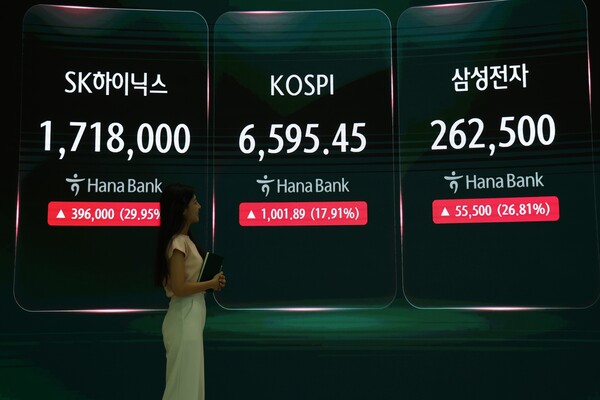
The KOSPI closed at 6,595.45 on July 31, up 1,001.89 points, or 17.91 percent, from the previous session. Both the point gain and the percentage rise were the largest on record. After falling about 17 percent over the three sessions from July 28 to 30, the KOSPI recovered 86 percent of that drop in a single day. Samsung Electronics jumped 26.81 percent and SK Hynix surged 29.95 percent.
In flow terms, the return of foreign investors stood out. Including trades on Nextrade, foreigners posted net purchases of 87.709 trillion won on July 31, the biggest on record. They bought 35.883 trillion won of SK Hynix and 21.03 trillion won of Samsung Electronics. Individuals, by contrast, sold a net 103.834 trillion won.
Easing concerns about AI investment underpinned the rebound. In recent earnings releases, U.S. big tech firms such as Microsoft, Meta and Amazon reaffirmed plans to continue investing in AI infrastructure.
With demand related to cloud services and AI remaining solid and capital expenditure (CAPEX) staying at high levels, concerns eased somewhat that the semiconductor investment cycle has passed its peak.
The industry sees the sharp market drop in July as more closely linked to a concentration in semiconductors, unwinding of leveraged investments and worsening sentiment than to corporate earnings themselves.
While the KOSPI's 12-month forward earnings per share (EPS) and profit forecasts for this year and 2027 kept rising even during the selloff, valuations fell to levels below those seen during the global financial crisis.
The Federal Open Market Committee (FOMC) in July kept its policy rate unchanged at 3.50 to 3.75 percent. While the market interpreted the decision as hawkish as 3 members argued for a 0.25 percentage point hike, there is also an assessment that high U.S. Treasury yields themselves are creating tight financial conditions.
This week, it has become important whether U.S. economic indicators will push bond yields higher again, rather than the prospect of an additional rate hike itself.
On Aug. 3, South Korea's July consumer price index and the U.S. Institute for Supply Management (ISM) July manufacturing index are due. The U.S. Job Openings and Labor Turnover Survey (JOLTS) is due on Aug. 4, and the U.S. ISM services index is scheduled for Aug. 5. The U.S. July jobs report is due on Aug. 7.
U.S. employment is the most important macro variable this week. If jobs data come in too strong, concerns could grow again about the possibility of a rate hike and the risk that high rates persist for longer.
If, on the other hand, labour market momentum cools without fuelling recession concerns, it could help stabilise U.S. Treasury yields and support domestic growth stocks.
Semiconductors are still expected to be at the centre of the rebound. With no major change in Samsung Electronics and SK Hynix earnings and the long-term outlook for memory demand, the recent sharp drop has significantly reduced valuation 부담.
The industry sees a chance that bargain hunting will continue, centred on large-cap semiconductor stocks that fell sharply in the short term.
The effect of regulations on single-stock leveraged exchange-traded funds (ETFs) also needs to be checked. From July 31, the minimum deposit rose to 30 million won from 10 million won, and substitute securities were excluded from deposit calculations.
On the first day of implementation, trading value in single-stock leveraged and inverse products linked to Samsung Electronics and SK Hynix fell to about a quarter of the previous day's level.
If the concentration of flows into large semiconductor stocks via leveraged products eases, sector rotation could also emerge into the Kosdaq and non-semiconductor sectors. Still, with market volatility recently extremely high, there is an assessment that investors need to focus not simply on stocks that have fallen heavily but on those whose profit outlook is being maintained or improving.
The industry views this rebound not as quickly recovering June's peak, but as a process of normalising prices and flows distorted during the sharp drop. Whether the recent pattern of the index moving more than 10 percent in a day subsides and foreign buying continues is expected to be a benchmark for judging the rebound's durability.
Ultimately, this week is expected to test whether the July 31 surge was a one-off relief rally or the start of normalising abnormally heightened volatility. If U.S. data do not increase the burden from interest rates and foreign buying of semiconductors continues, the KOSPI could move to recover additional losses. If interest rates and oil prices rise again or foreign flows pull back once more, the possibility of large swings remains.
Lee Kyung-min (이경민), a researcher at Daishin Securities, said, "The KOSPI is currently passing through the worst phase, with fear-driven sentiment, worsening flows and deleveraging selling under way," and added, "Even just an easing of the burden from concerns about AI and semiconductor industry conditions and earnings, and from oil prices, inflation and interest rates, makes it highly likely the market could enter a rebound phase."
 Sangyeop Oh
yub@d-today.co.kr
Sangyeop Oh
yub@d-today.co.kr