
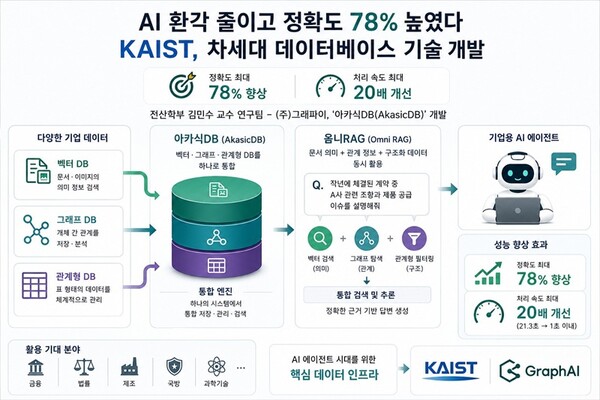
[DigitalToday reporter Jin-ho Lee] Researchers at KAIST developed database (DB) technology that analyzes documents, data and relationships among entities at once to reduce hallucinations in enterprise artificial intelligence (AI) agents. They said it boosts answer accuracy by up to 78 percent compared with existing retrieval-augmented generation (RAG) and improves complex search speeds by more than 20 times.
KAIST said on June 19 that a team led by Professor Minsoo Kim (김민수) of its School of Computing developed 'AkashicDB', which integrates a vector DB, graph DB and relational DB into a single database management system (DBMS), along with 'OmniRAG' based on it, in collaboration with faculty startup Graphy.
Recently, enterprise AI agents mainly use RAG technology to generate answers by searching internal company documents and expert knowledge. However, corporate data is dispersed across formats such as documents, tables and relationships among entities, limiting comprehensive analysis, the researchers said. In the process, hallucinations occurred in which AI generates answers that differ from the facts without sufficient evidence.
OmniRAG developed by the team handles vector search for finding document meaning, graph traversal for analyzing relationships among entities, and relational filtering that distinguishes dates and types, within a single query and execution plan. By using document meaning, relationships among entities and structured data in table form at the same time, it enables AI to find evidence needed for answers more accurately.
To support this, AkashicDB integrates a vector DB, graph DB and relational DB into a single engine. Users can write a composite RAG query combining each search function as a single SQL·GQL statement. AkashicDB optimizes and processes it as a single execution plan. The integrated structure reduces data movement between databases and unnecessary intermediate results, cutting large language model (LLM) token usage and response latency as well.
In experiments, it processed composite search queries that took up to 21.3 seconds in existing systems in under 1 second, recording performance improvements of more than 20 times. OmniRAG's answer accuracy also rose by up to 78 percent compared with existing RAG.
Kim said, "For AI agents to accurately understand and use companies' vast data, infrastructure is needed that can integrate and process vector, graph and relational data within a single system." He added, "We expect it to be used as core data infrastructure in fields requiring high reliability such as defense, manufacturing, finance, law and science and technology."
Meanwhile, Gun-ho Lee (이건호), a doctoral student in KAIST's School of Computing, participated in the research as first author. The results were presented as a demo paper on June 2 at ACM SIGMOD 2026, an international conference in the database field.
 Jin-ho Lee
jhlee26@d-today.co.kr
Jin-ho Lee
jhlee26@d-today.co.kr