
The Korea Internet Self-Governance Organization (KISO) has set standards to block fake news and manipulated information that will apply to large platforms ahead of the revised Information and Communications Network Act taking effect. It fully excluded private spaces for user-to-user conversations from regulation, citing constitutional protections of communications secrecy.
KISO announced on June 19 that it had finalised its 'Self-Policy Guidelines on False and Manipulated Information'.
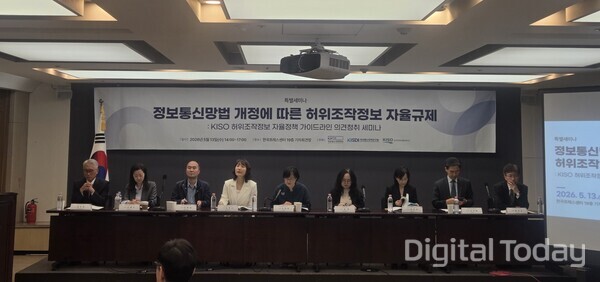
The guidelines are part of the self-operating policies large information and communications service providers must establish in line with the revised law, which takes effect on July 7. KISO completed revisions and supplements after a public hearing on May 13. They are expected to apply first to KISO members such as Naver and Kakao.
The scope of application stands out. The revision allows users to report the distribution of false and manipulated information on platforms to operators, but KISO excluded private communication services such as messengers, email and direct messages from the guidelines. The intent is to regulate mainly publicly available information and pre-empt disputes over infringement of personal privacy.
It also presented detailed guidelines that platforms can apply in actual services. Not only the original producers of false and manipulated information but also distributors are subject to sanctions. Platforms are instructed to review overall factors, including the truth of the core message, the overall context and whether there is a deceptive appearance intended to mislead users, rather than focusing on simple alterations of information or partial factual errors.
It also set out exceptions to prevent chilling effects on freedom of expression. Expressions of subjective opinion, value judgments, academic debates where objective truth is not settled, and clearly fictional cultural and artistic creative works are, in principle, excluded from sanctions.
If reported information is found to be false and manipulated information, platforms may take measures such as deletion, blocking access and restricting accounts. For cases that are difficult to judge, platforms may request deliberation by the newly established 'KISO Special Committee for Deliberation on False and Manipulated Information'.
It also plans to limit acceptance of reports to prevent abuse of the system, including repeated reports of similar content, reports filed using automated tools, malicious targeted reports and reports intended to chill expression activities. Member companies must transparently disclose report and action results every six months.
KISO Chair Min-ho Kim (김민호) said, "We fully recognise that along with the need to respond to false and manipulated information, there are persistent concerns that it could chill freedom of expression." He added, "We will continue a balanced self-policy that can protect users while ensuring that normal press reporting, raising issues in the public interest, criticism of public figures, satire and expressions of opinion are not easily restricted."
 Ho-jeong Lee
lhj@d-today.co.kr
Ho-jeong Lee
lhj@d-today.co.kr