
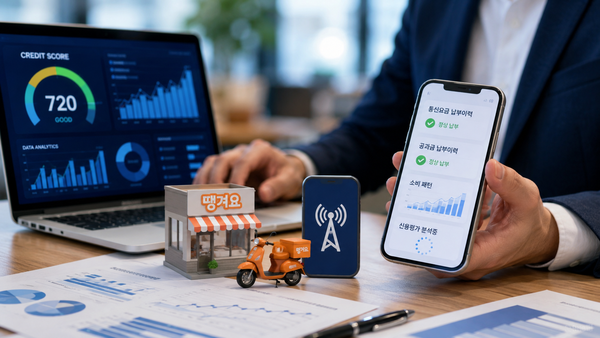
Non-financial businesses pursued by the banking sector, such as delivery apps and budget mobile services, are emerging as alternative credit assessment infrastructure for inclusive finance. The need for credit evaluation is growing for small merchants, young workers and freelancers who find it hard to be fully assessed based only on existing financial transaction history.
Shinhan Financial Group recently launched its 5 trillion won "Inclusive Finance 2.0 ON" project and set expanding the use of alternative credit assessment models as a key task. Shinhan Bank developed a "people's alternative credit assessment model" late last year using non-financial data such as living expenses, utility bills and automatic payments, and has applied it to loans for ordinary borrowers since March. It plans to reflect the model in screening for a new mid-rate loan product due for launch in the third quarter.
A notable element is the use of data from the delivery app "Ttaenggyeoyo". Shinhan Financial said it will expand funding for small and medium-sized enterprises and small merchants by using alternative information based on Ttaenggyeoyo and ERP data from Jeju Bank's digital corporate finance-focused brand, "DJ Bank". Information such as orders, sales flow, transaction continuity and business-site operations can serve as indicators of a small merchant's actual business performance that is hard to capture through screening centered on financial statements or collateral.
Banks' non-financial businesses have faced criticism for showing limits in profitability. Delivery apps face fierce platform competition, and budget mobile services are often seen as having little direct connection to banks' core business. With the push for inclusive finance strengthening, expectations are growing that these businesses can be used not as simple add-on services but as data foundations to reduce blind spots in finance.
Budget mobile services are also drawing attention in the same context. Telecom bill payment histories are cited as a key type of non-financial information that can help gauge repayment tendencies of customers with insufficient financial transaction records. Customers such as young workers or homemakers with limited loan or card usage may receive unfavorable assessments under existing credit evaluation systems, but access to finance could improve if telecom or utility payment histories are used as supplementary indicators. For this reason, KB Kookmin Bank has prepared an alternative credit assessment model using telecom data from its mobile service, KB Liiv M, since 2024. As the importance of alternative assessment models is highlighted, their importance appears to be rising again.
The effect of alternative credit assessment is also being confirmed at internet-only banks. KakaoBank supplied an additional 1.2 trillion won in mid- and low-credit loans using an alternative credit assessment model made up solely of non-financial data. The recipients are individuals and sole proprietors who were rejected for loans under a model centered on existing financial information but had their repayment ability 인정받은 through alternative information such as distribution and remittance data.
KakaoBank Score was applied to credit loan screening to improve differentiation for mid- to low-credit borrowers and thin-file customers. In the personal business loan area, it also operates industry-specific models to assess restaurant operators and online sellers.
Across the banking sector, the use of alternative information is also spreading. Hana Financial Group also said it recently introduced additional non-financial alternative information and plans to apply it to its personal finance credit assessment model in the second half of the year. It plans to newly introduce seven types, including information from the Korea Financial Telecommunications and Clearings Institute, Kyobo Book Centre and tax refund information, in addition to telecom information, small mobile payments, commerce information and card merchant information.
NH Nonghyup Financial also plans to finalize in the second half a machine learning screening strategy based on alternative information reflecting telecom, tax and utility payment histories, traditional market and public transportation usage records, and merchant sales information for sole proprietors. Woori Bank also said it will widen the credit bands eligible for loans by using alternative credit assessment that reflects non-financial data such as telecom and small payments along with financial transaction histories.
The policy direction of financial authorities is also supporting the spread of alternative credit assessment. The Financial Services Commission launched a task force this year to overhaul the credit assessment system and is discussing revamping the personal credit assessment system, activating alternative credit assessment and advancing credit assessment for small merchants. The aim is to approach inclusive finance not as one-off support but as a revision to the way the financial system operates.
A financial sector official said, "The key will be the balance in using data," adding, "For non-financial businesses such as delivery apps and budget mobile services to establish themselves as practical infrastructure for inclusive finance, it will become important to secure reliability and explainability rather than the amount of data."
 Ji-young Lee
ljy@d-today.co.kr
Ji-young Lee
ljy@d-today.co.kr