
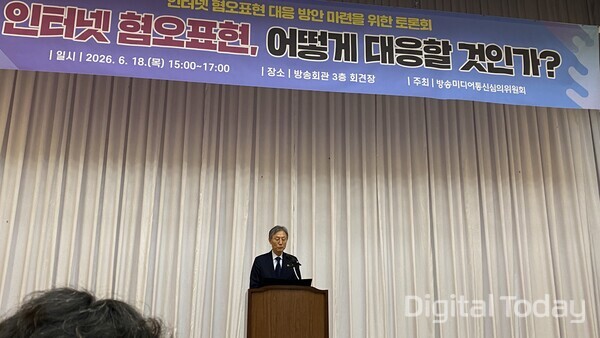
[Digital Today reporter Seulgi Son] The Broadcasting Media and Communications Review Committee is moving in earnest to overhaul systems to respond to online hate speech.
At a forum on June 18 at the Korea Broadcasting Hall in Mok-dong, Seoul, Ko Kwang-heon (고광헌), chairman of the committee, said content that mocks and satirises historical events and social pain is repeatedly spreading, heightening social concern. He said institutional review is needed as online hate speech spreads faster and has greater ripple effects, and that views discussed would be reflected in future policy and institutional improvements.
Controversies over hate speech have continued steadily since the 2013 Ilbe bulletin board incident. The 2016 Gangnam Station murder of a woman and 2017 protests against Yemeni refugees were repeated. On May 23, visitors believed to be Ilbe users again sparked controversy with mocking acts at an event marking the 17th anniversary of the death of former President Roh Moo-hyun.
The fallout grew after President Lee Jae-myung shared the incident directly on social media. On May 24, Lee wrote on his social media account that steps such as shutting down sites that stoke hatred like Ilbe, punitive damages and penalty surcharges should be reviewed. He added he would also instruct a cabinet meeting. Discussion of shutting down Ilbe was also pursued under the Moon Jae-in government in 2018 but was halted. Because Ilbe contains a mix of general posts, it failed to meet the committee's review standards as it could not prove that more than 70 percent of posts were illegal information.
At the forum, experts suggested regulating by law only extreme hate speech with clear social harm, taking into account regulatory effectiveness. They said milder hate speech should be addressed by creating an environment through education and publicity.
Hong Sung-soo (홍성수), a professor at Sookmyung Women's University's law faculty who presented at the forum, said limited regulation of conduct should apply within a narrow range where harm is clear, such as incitement of hatred. If regulation is imposed, he said, the effect of regulation relative to its cost should be considered.
Hong stressed that freedom of expression is not unlimited. He said both U.S.-style and Europe-style hate speech bans have limits and that an either-or choice does not solve the problem. He said the United States has no hate speech ban, but its anti-discrimination law and laws that increase punishment for hate crimes are instead strict. He also noted Europe has hate speech bans, but actual prosecutions and punishment cases are extremely limited.
Hong assessed the revised Information and Communications Network Act, set to take effect on July 7, as positive in that it adds a ban provision to the law for the first time since discussions of hate speech in the 2010s. He also pointed to a limitation in that the revised law is limited to deletion and blocking at the post level and lacks mechanisms to hold platforms or operators responsible. He added that provisions to hold platforms accountable and specific guidelines should follow.
◆"Regulating hate speech, criminal punishment is a last resort"...consensus at forum
Forum participants largely agreed on the need for responses short of criminal punishment.
Jung Seul-a (정슬아), head of the gender equality media and anti-discrimination team at the Korea Women's Association United, cited cases where online hate led to physical violence and said there are expressions that clearly should not be left unattended in the name of freedom of expression. She added that creating and disclosing Bamisin guidelines in cooperation with experts and the National Human Rights Commission of Korea could reduce censorship controversy.
Lee Seung-hyun (이승현), an adjunct professor at Yonsei University's law school, said education and a shift in awareness should come before regulation. He cited comprehensive hate response guidelines prepared by the Canadian federal government in 2024.
Choi Jin-eung (최진응), a legislative researcher at the National Assembly Research Service, said South Korea's hate speech regulation is closer to the European model. He said the latest revision to the Information and Communications Network Act added provisions related to information that promotes hatred and hate, but unlike existing defamation provisions, it excludes criminal punishment. "I do not see it as a criminal punishment approach," he said.
Choi Hang-seob (최항섭), a sociology professor at Kookmin University, voiced concern that a law that includes a "specific individual" could be abused to protect those in power. He also said it is dangerous for democracy if people become unable to speak out out of fear of state authority.
◆National Assembly: "Presidential instruction...we will provide support"
The National Assembly also expressed willingness to support legislation. In a keynote speech at the forum, Lee Ju-hee (이주희), a lawmaker from the Democratic Party, said South Korea needs a Korean-style Digital Services Act that differentiates obligations according to the size and function of online intermediary services. She stressed that hate speech is now a democracy issue.
Kim Hyun (김현), also from the party, said the president made the same request twice, on social media and at a cabinet meeting in November last year. She said if an institutional foundation is needed, lawmakers should actively provide opinions, and Democratic Party lawmakers would step forward to support legislation.
The two lawmakers completed their first-half terms on the parliamentary Science, ICT, Broadcasting and Communications Committee last month and are waiting for assignments to standing committees for the second half.
Bamisin plans to establish review standards based on expert opinions gathered through the forum. It also plans to make long-term efforts so the work can lead to substantive legal and institutional improvements.
 Seulgi Son
sageson@d-today.co.kr
Seulgi Son
sageson@d-today.co.kr