
[DigitalToday reporter Jinju Hong (홍진주)] Image-generation AI company Midjourney has declared it is entering the medical device market. The company said it is developing scanning equipment that visualises the inside of the entire body in 3D. It said its long-term goal is to build a full-body diagnostic platform that is much faster than MRI.
On June 18 (local time), major foreign media outlets including online publication Gigazine reported that Midjourney recently established a new business unit, Midjourney Medical, and unveiled plans to develop the full-body scanning device Midjourney Scanner.
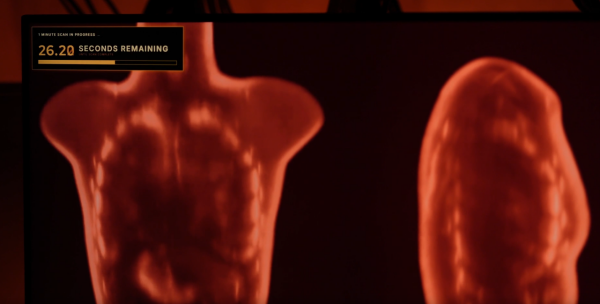
The Midjourney Scanner is a cylindrical device large enough to fit one person. The inside is filled with water, and scanning is performed when a user enters the device and stands for about 30 seconds. The company explained that it can generate a 3D map analysing the inside of the human body down to the millimetre level.
The core technology is an ultrasound-based imaging system. Inside the device are about 500,000 ultra-small acoustic units that function as both speakers and microphones. These units emit ultrasound toward the body and collect reflected signals to analyse internal structures.
The collected data is processed through an AI-based computing system. Midjourney said the device generates terabyte-class data per second. It said it has been difficult to implement similar systems in the past because computing power was insufficient to process data of that scale in real time.
The company plans to combine the many cross-sectional images produced during the scan to build a 3D map showing the condition of muscles, organs and tissues. It claimed it can have a major competitive advantage in processing speed compared with existing medical imaging equipment.
Midjourney said it can generate a 3D map at speeds up to 100 times faster than MRI. It said a significant time-saving effect can be expected compared with a typical MRI exam that takes tens of minutes or longer.
But the technology remains at an early development stage. Development of a first-generation prototype is under way, and the company plans to improve hardware and algorithms over the next 12 months and begin designing a second-generation product.
It also disclosed a commercialisation roadmap. Midjourney plans to build a dedicated facility in San Francisco in late 2027 where the public can experience the device. The company described it as a "Midjourney Scanner Spa". It then aims to introduce a third-generation model in 2028 and said it aims to install about 50,000 scanners worldwide by 2031.
It is also pursuing medical device certification procedures. Midjourney said it is developing the device as a medical-grade instrument and plans to continue submitting relevant test data with the goal of securing approval from the U.S. Food and Drug Administration (FDA).
The industry is paying attention because the announcement shows Midjourney, known as an image-generation AI company, expanding beyond software into the medical hardware market. Midjourney has grown with an AI service that generates images from text input, but this time it has directly moved to develop medical imaging equipment combining ultrasound and AI computing technology.
At this stage, however, the performance figures and commercialisation plans presented by the company have not been verified in actual medical settings. The claimed processing speed of 100 times faster than MRI and the ability to generate millimetre-level full-body 3D maps will also require verification through clinical trials and regulatory review.
The industry sees that if the Midjourney Scanner is approved as an actual medical device, it could become a new case of an AI company entering medical diagnostic hardware. On the other hand, it expects that whether it is actually commercialised will depend on development over the next several years and test results, given the high level of technical difficulty and the barrier posed by medical regulation.
 Jinju Hong
hongjj@d-today.co.kr
Jinju Hong
hongjj@d-today.co.kr