
Ford has started producing lithium iron phosphate (LFP) battery cells in the United States as it moves to target the mass-market electric vehicle segment. It is seeking price competitiveness by making in the United States LFP batteries that Chinese companies have effectively dominated.
Electrek, an electric vehicle outlet, reported on Tuesday that Ford succeeded in producing its first LFP battery cells at BlueOval Battery Park in Michigan. The batteries are set to be installed in a mid-size electric pickup in the $30,000 range due to be launched in 2027.
Chief Executive Jim Farley (짐 팔리) said the company produced its first fully finished LFP cells that day. Ford built its production system by licensing CATL’s technology and manufacturing processes.
With the start of production, Ford became the first automaker to produce LFP batteries for mass-market passenger cars in the United States. BlueOval Battery Park is currently producing prismatic LFP battery cells that will go into vehicles based on Ford’s next-generation electric vehicle platform, Universal EV (UEV).
The first model to use the cells will be an affordable mid-size electric pickup to be launched in 2027. Ford expects the vehicle to cut manufacturing costs versus existing electric vehicles while securing both efficiency and profitability. It also plans to use the produced LFP batteries in its energy storage system (ESS) business.
Ford has long stressed that LFP battery production is essential to expand low-priced electric vehicles in the United States. Lisa Drake (리사 드레이크), Ford’s vice president of platform program and EV systems, said last year that it decided to produce prismatic LFP batteries in the United States to make truly reasonably priced electric vehicles.
LFP batteries have lower energy density than nickel-cobalt-manganese (NCM) batteries, but are cheaper and have higher safety, Ford said. It also said this would help it cut battery costs and reduce vehicle weight while improving cabin space usability.
The company claimed the new electric pickup will offer more interior space than the Toyota RAV4 and have a lower total cost of ownership than the Tesla Model Y. It said this means it will prioritize price competitiveness as its top goal to popularize electric vehicles.
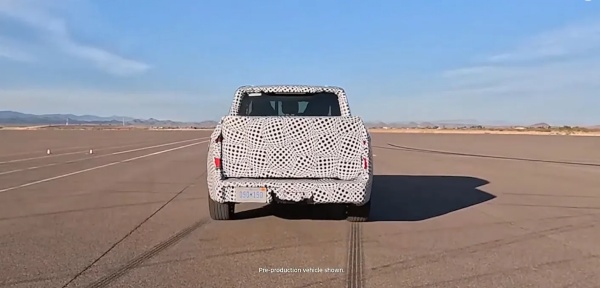
Preparations for the launch are also gaining pace. In the Long Beach area, a camouflaged prototype was recently spotted undergoing road tests. It was also reported that the vehicle had a QR code attached that links to a dedicated webpage. Ford plans to produce the electric pickup at its Louisville Assembly Plant in Kentucky and begin deliveries shortly after its 2027 launch.
The production start also coincides with shifts in the global battery supply chain. The LFP battery market is currently led by Chinese companies such as CATL and BYD. SNE Research said CATL and BYD together accounted for more than 55 percent of global electric vehicle battery sales last year. Over the same period, LFP cathode materials made up about 72 percent of 4.95 million tonnes of cathode materials shipped.
Industry watchers see Ford’s U.S.-made LFP battery production as a key turning point in price competition for mass-market electric vehicles. As competition to cut electric vehicle prices intensifies, battery cost reductions are directly tied to profitability, raising the possibility that U.S. automakers will expand adoption of LFP batteries further.
By contrast, General Motors once announced plans to expand the use of LFP batteries but has recently been reported to be reviewing its strategy. Attention is focused on whether Ford can lead U.S. production of LFP batteries and secure an advantage in the mass-market electric vehicle segment.
 Jinju Hong
hongjj@d-today.co.kr
Jinju Hong
hongjj@d-today.co.kr