
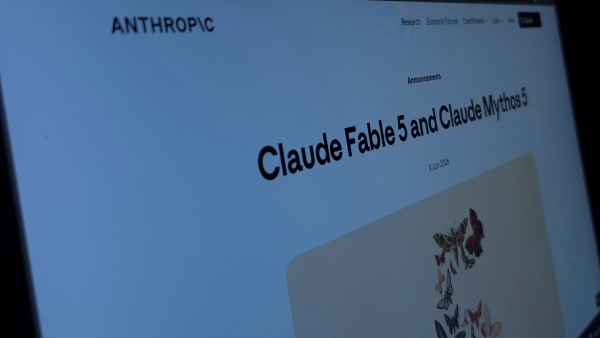
Anthropic has abruptly suspended access to some AI models in line with U.S. government export-control guidance, and companies are showing signs of changing their AI strategies. As concerns grow that reliance on a specific vendor’s closed model could be blocked by policy or regulatory shifts, the value of open-source AI models that can be run in-house is again drawing attention.
CNBC reported on June 16 that Anthropic recently cut off access to its flagship AI models, Fable 5 and Mythos 5. The company described the move as steps to comply with U.S. government export-control guidance tied to national security. The models were disabled across all customers, while services for other models are operating normally.
The move is being seen as having significance beyond a simple service change. It showed that the AI models companies use can be cut off without notice by government regulation and geopolitical variables, rather than technical issues or pricing policy.
In particular, calls are growing among corporate clients to reduce dependence on closed models run by external operators and to secure open-source models that can be operated internally. Open-source models installed and run directly on company servers are relatively less likely to be immediately halted due to vendor policy changes or international developments.
Investors also responded quickly. Market attention focused on open models that can be downloaded and operated in-house, and stocks related to Chinese AI research institutions MiniMax and Zhipu showed gains. It underscored that even as the valuations of closed AI model companies keep rising, actual demand could shift toward models that allow users to retain control.
Satya Nadella (사티아 나델라), Microsoft’s chief executive, also stressed on X, formerly Twitter, on the same day that companies should retain intellectual property rights and operational control as they build AI agent systems. "No one wants a world where every industry’s companies hand value over to a handful of AI model providers," he said.
Corporate customer demands are also shifting in a similar direction. Yassi Patel (야시 파텔), CEO of Applied Compute, which supports building custom AI models for companies, said the situation again showed the importance of owning an in-house model. He said customer attitudes have changed noticeably over the past month, and more companies are asking for an environment where they are not tied to a specific operator and can use various models.
Changes in AI cost structures are also accelerating the trend. As the cost of using cutting-edge AI models has risen, companies are shifting strategies by using cheaper models for routine work and using high-performance models only for complex tasks.
Patel called this "Tokenpocalypse." He said the era of near-unlimited AI use is ending, giving way to a period focused on cost effectiveness. Companies are now looking for models that are cheaper and faster while providing sufficient performance, rather than the most powerful model, he said.
In the process, the influence of Chinese open-source AI models is also growing. Among the most-used models on the OpenRouter platform are those from DeepSeek, Tencent, Xiaomi and MiniMax. Chinese AI company Zhipu also argued during a recent new model unveiling that advanced AI should not become the exclusive asset of a particular company or have access arbitrarily blocked.
Corporate perceptions are also changing. In the past, many companies excluded Chinese open models from consideration for security and political reasons, but more companies recently are considering adoption if performance and cost competitiveness are sufficient, the report said.
Industry views Anthropic’s move as an event showing a new competitive structure in the AI market. The market has focused on the technology race among closed-model companies such as OpenAI and Anthropic, but corporate customers have begun to weigh not only performance but also cost, accessibility, supply chain stability and the risk of vendor lock-in, it said.
Ultimately, the battle for leadership in the AI market is expanding beyond a simple contest over model performance into a question of who can provide control more reliably. As a result, the AI industry is increasingly likely to be reshaped toward coexistence between closed, hyperscale model companies and a camp of open models that can be run in-house.
 Jinju Hong
hongjj@d-today.co.kr
Jinju Hong
hongjj@d-today.co.kr