
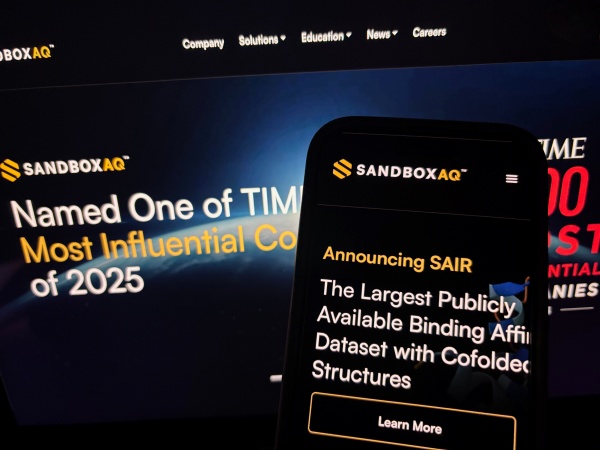
The U.S. government plans to put $500 million into SandboxAQ, a U.S. artificial intelligence and quantum technology company spun off from Google parent Alphabet, and also take a minority stake.
Cryptopolitan, a blockchain media outlet, reported on Tuesday that the funds will be used to develop chemicals and materials for U.S. semiconductor plants.
The support is one of the projects President Donald Trump is carrying out using research funds under the CHIPS Act. The U.S. government previously allocated $150 million for semiconductor manufacturing equipment and $2 billion for quantum computing. SandboxAQ was valued at $5.75 billion as of April 2025, and its cumulative funding has exceeded $1 billion. Nvidia is also an investor in the company.
The focus is on reducing weak points in the semiconductor supply chain. The U.S. Commerce Department wants outputs that can be put directly into the market in areas where U.S. semiconductor companies face shortages, bottlenecks or risks from reliance on overseas suppliers. SandboxAQ plans to find PFAS substitute materials and performance-enhancing materials used in semiconductor production, and develop catalysts to speed chemical reaction rates in chip manufacturing processes. The task also includes ways to reduce or replace rare earths from China or other overseas markets used in permanent magnets and batteries in manufacturing equipment.
SandboxAQ has developed AI models that solve scientific problems based on physics data and experimental results. Its models use laboratory measurements and physics data rather than learning from human writing or software code. The company sees this approach as suited to problems that general chatbots do not handle well. SandboxAQ has already applied the same approach to biotechnology design and to developing quantum navigation devices that operate without GPS.
The contract terms are also drawing attention. The U.S. Commerce Department will receive a minority stake in SandboxAQ through the deal. SandboxAQ Chief Executive Jack Hidary (잭 히대리) said the size of the stake has not been disclosed, but it has no voting rights and the federal government will not have a board seat.
Separately, the U.S. government's enforcement of technology restrictions on China is moving on a different track. More than 100 Chinese technology companies, including DeepSeek and memory chipmaker CXMT, were classified as national security threats but have not yet been placed on the Commerce Department's Entity List, which restricts transactions. The companies passed an interagency review last year, but the list has not been made public.
The Bureau of Industry and Security said it uses various policy and enforcement tools, including the Entity List, every day to respond to malicious actors. China's foreign ministry, meanwhile, demanded that the United States stop politicising, instrumentalising and weaponising economic, trade and technology issues. Spokesman Lin Jian (린젠) said China has consistently opposed broad interpretations of the concept of national security and the abuse of export control measures such as the Entity List.
With U.S.-China tensions continuing, the SandboxAQ investment is seen as a measure that places more weight on industrial promotion than regulation. The United States is seeking to bring critical supply chains needed for semiconductor materials and equipment into the country, while China still maintains strong influence over supplies of rare earths needed for semiconductors, autos and defence. In this situation, the U.S. government's move to secure a stake directly and invest funds in materials development is linked to efforts to strengthen the semiconductor manufacturing base.
 Jinju Hong
hongjj@d-today.co.kr
Jinju Hong
hongjj@d-today.co.kr