
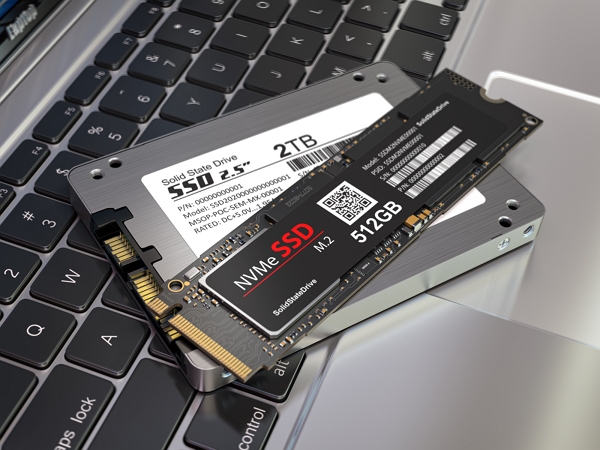
The retail solid-state drive (SSD) market has effectively shrunk sharply since the first half of this year, according to an industry assessment.
On June 17, local time, online media outlet Gigazine reported that Nelson Duan, a vice president at Silicon Motion, the world’s largest NAND flash company and the top SSD controller company, said, "The retail SSD market has almost disappeared."
The remarks do not mean demand for consumer SSDs has completely vanished. They more closely mean that end demand for SSD controllers supplied by Silicon Motion to module makers has largely shifted from retail products to OEM products. Duan explained that a significant share of volumes using the company’s controllers is now flowing into finished SSDs for PC makers.
Behind the shift is a reshuffle in NAND flash supply. As NAND makers reduce allocations to client PCs and the consumer market and divert more volume to data-centre products, PC makers have found it harder to secure enough NAND or SSDs directly from NAND suppliers, he said. Duan pointed out that PC makers are changing their procurement methods because of these changes.
PC makers such as Acer, Asus, Dell and HP are stepping up moves to procure finished SSDs from SSD module makers. In the past, these module makers had a larger share of aftermarket SSDs with high performance or cooling features, but recently the share supplied to PC makers has become larger.
Duan said the supply-and-demand shift became more pronounced from the second half of 2025 through this year. He said OEM demand has strengthened significantly, and as a result a substantial portion of module makers’ output is going directly to PC makers. In this trend, the volume of consumer SSDs released to the retail market has decreased relatively.
The same trend is also playing out in prices. The SSD market has recently seen large price increases under the impact of the AI boom, and there were even reports that the price of high-capacity NVMe SSDs rivals that of gold by weight. The contraction of the consumer market is tied not simply to a change in sales channels but also to a shift in memory supply priorities toward AI data centres.
The structural shift has differing effects across participants in the SSD ecosystem. It could increase the burden on companies that rely heavily on the consumer retail market, but it is opening other opportunities for standalone SSD controller companies. The explanation is that companies like Silicon Motion, which are connected to module makers and demand for server drives, are facing a broadly favourable environment.
Ultimately, the core of the change is not the disappearance of SSD demand itself but a shift in where that demand goes. As NAND supply moves from consumer uses to AI data-centre uses, the SSD market’s centre of gravity is shifting from retail to OEM. Whether the consumer SSD market recovers will depend on how much NAND supply returns to client PCs and retail channels.
 Jinju Hong
hongjj@d-today.co.kr
Jinju Hong
hongjj@d-today.co.kr