
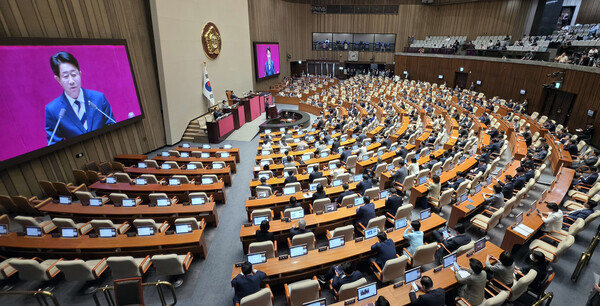
[DigitalToday reporter Sangyeop Oh (오상엽)] Expectations are rising that discussions on the Digital Asset Framework Act will resume after the June 3 local elections, but whether it will be handled within the year remains unclear. Full-scale review of the bill will be possible only after the 22nd National Assembly completes its second-half leadership lineup and the Political Affairs Committee is reorganised. Observers say the pace of talks could also change depending on what plan the government puts forward.
According to political circles and the digital asset industry on Wednesday, the ruling and opposition parties are expected to treat the Digital Asset Framework Act as a key agenda item at the regular National Assembly session in September.
Still, the situation surrounding the Democratic Party’s digital asset task force has become more complicated than before. Some say the task force has been dissolved, weakening legislative momentum, but whether it has been disbanded is not clear. Others say its activities have slowed during the process of forming the second-half Assembly leadership.
Within the Democratic Party, there is talk of reinstalling the digital asset task force after its parliamentary bodies are reorganised, or shifting discussions to the Political Affairs Committee.
As a result, it is hard to say a task force vacuum immediately means a halt in legislation. But there are assessments that it will be inevitable to adjust the pace until the reviewing body and discussion structure are sorted out.
The biggest variable is a government proposal. If the Political Affairs Committee begins legislative work in earnest, the government is likely to submit its position and move to coordinate with the National Assembly. In that process, limits on major shareholders’ stakes in digital asset exchanges and restrictions on who can issue won-based stablecoins could re-emerge as key issues.
A plan previously known as a financial regulator proposal was reported to include limiting major shareholders’ stakes in digital asset exchanges to 15 to 20 percent and setting the issuer of won-based stablecoins as a bank-led consortium.
In the industry, concerns are being raised that if such a plan returns to the discussion table, it could restrict market entry and shake the management stability of existing operators.
On the other hand, financial regulators’ sense of concern remains that investor protection and market stability must be ensured. Their stance is that standards for issuance, distribution, custody, settlement and internal controls should be clarified as the digital asset market is brought into the institutional framework.
In the industry, there is also talk of a compromise in which, rather than handling all issues at once, lawmakers first discuss market-infrastructure provisions such as stablecoins, spot digital asset exchange-traded funds (ETFs) and token securities (STOs), while pushing highly contentious issues such as exchange governance and major shareholder regulation to further talks.
In South Korea, brokerage of overseas spot bitcoin ETFs and issuance of domestic spot ETFs are effectively restricted. But as the introduction of spot ETFs and institutionalisation of token securities are being discussed in connection with policy tasks, there is a possibility that in the second half of the year lawmakers will also discuss a digital asset regulatory system, won-based stablecoins and expanding blockchain-based financial infrastructure.
Changes are also continuing on the market-infrastructure front. Korea Securities Depository is reviewing expanding its role in digital asset market infrastructure, including custody of underlying assets for won-based stablecoins, safekeeping of underlying assets for spot digital asset ETFs and building a token securities platform.
The NXT consortium led by Nextrade is also speeding up procedures to establish an over-the-counter exchange for fractional investment. After receiving preliminary approval for the exchange, the consortium applied to the Financial Services Commission for approval of an investment contribution and is preparing to launch a new corporation, Nexchange. If token securities distribution infrastructure is put in place, it could also tie into discussions on the Digital Asset Framework Act.
The Fair Trade Commission’s review of a business combination between Dunamu and Naver Financial is also a variable. The commission recently asked major securities firms for their views on brokerage of unlisted shares and on digital asset exchanges and stablecoins.
In the securities industry, concerns have been raised that a combination between the top simple-payment operator and the top operator in digital assets and unlisted-share trading could increase customer lock-in effects and barriers to entry.
Overseas, efforts to overhaul digital asset regulation are moving quickly. The United States is pushing ahead with stablecoin rules, a digital asset market structure bill and an overhaul of jurisdiction between the Securities and Exchange Commission (SEC) and the Commodity Futures Trading Commission (CFTC).
In South Korea, voices are growing that at least minimum market rules and investor-protection devices should be put in place so the country does not fall behind in global competition over systems.
An industry official said, "There is agreement on the need for legislation within the year, but if a government proposal tilts toward restricting market entry, passage of the bill could be delayed again." The official added, "With complex discussions intertwining at the same time, there are quite a few variables before the Digital Asset Framework Act can be handled within the year."
 Sangyeop Oh
yub@d-today.co.kr
Sangyeop Oh
yub@d-today.co.kr