
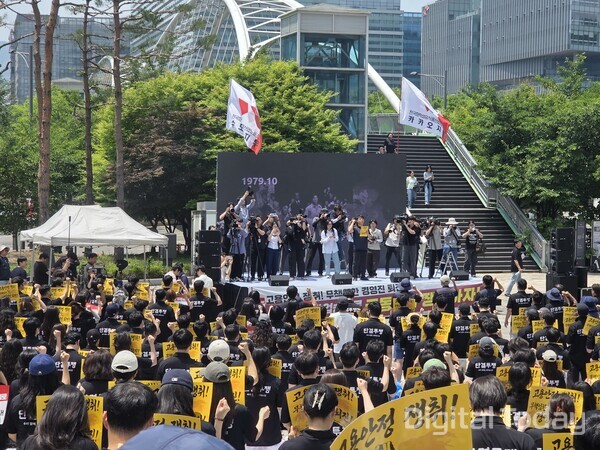
Kakao’s first-ever strike at its headquarters is heightening concerns that its artificial intelligence (AI) transition strategy could face disruption. The union has also warned of a second strike on June 29. The share price has stayed weak since the strike, without a clear rebound.
◆ A 20 billion won gap masking a 1.8 trillion won burden
The visible gap in this labour-management dispute is not large. The union is demanding that 13 to 14 percent of last year’s operating profit be set aside for performance pay, while management has proposed about 10.1 percent of operating profit, including RSUs worth 5 million won. In value terms, management’s proposal is about 73.9 billion won, while the union’s demand is 95.2 billion to 102.5 billion won, for a maximum gap of 28.6 billion won.
Behind the failure to narrow differences lies a cost structure problem. Kakao’s consolidated cash-based labour costs last year, including salaries, severance pay and welfare benefits, totalled 1.85 trillion won, or 2.5 times operating profit for the year. They accounted for about 25 percent of total operating expenses. Cash-based labour costs increased even though the number of group employees fell from a year earlier, following expansion of affiliates during the growth phase and large-scale hiring.
Five entities are participating in the strike, but Kakao has many more affiliates across the group. If the bargaining standard spreads across the wider group, the costs management must bear could far exceed the amount in the current talks.
The union’s demands also go beyond a simple increase in performance pay. Issues have erupted at once, including distrust of management’s method of counting RSUs as part of performance pay, job insecurity tied to affiliate restructuring such as recommended resignations at DK Techin, voluntary retirement at XL Games, and the sale of AXZ, the operator of portal Daum, as well as the gap between executive compensation and employee pay.
Park Sung-eui (박성의), senior deputy head of Kakao’s union branch, also addressed this at a rally, asking, "Executives’ pay rose 30 percent, so why did employees’ pay increase only 3 percent?" It has become an issue of trust in management rather than a simple wage negotiation.
◆ Share weakness continues after strike
On June 10, when the strike took place, Kakao shares fell as low as 37,400 won intraday, setting a new 52-week low. On the next day, June 11, they also hit 36,500 won intraday. The stock has fallen more than 15 percent over about a month since May 10, when the performance-pay conflict first surfaced. On June 17, Kakao shares closed at 40,550 won, up 0.25 percent from the previous session. It was a slight rebound, but the stock has still not escaped a weak trend compared with levels before the strike.
Shareholders’ reaction is cold. The Korea Shareholder Activism Headquarters said it would take legal action if a compensation plan linked to operating profit is ratified through the board. Kakao failed to join a rally led by AI beneficiary stocks, and a pattern is repeating in which it is the first to fall in down markets.
An industry official said, "It will be difficult to drive a rebound in the share price through earnings improvement alone. If strike risk and uncertainty over AI monetisation are not resolved at the same time, it will be hard for investor sentiment to turn around."
◆ AI shift, timing is the issue
The issue is that internal conflict has surfaced at a time when Kakao needs to accelerate AI investment the most. CEO Chung Shin-a (정신아) said at the company’s first-quarter earnings release that it plans to transform KakaoTalk from a simple messenger into an 'agentic AI platform'. As of the end of the first quarter, Kakao held liquidity of about 8 trillion won, including cash and cash equivalents and short-term financial products. It has recently sold part of its stake in Dunamu and control of Kakao Games in succession, and has introduced AI services such as Kanana in KakaoTalk and ChatGPT for Kakao.
But the AI transition period is also when costs pile up at once. Labour costs rise alongside data centre investment and model development expenses. With domestic KakaoTalk users reaching saturation and competition intensifying in the advertising and commerce markets, the past approach of offsetting costs through top-line expansion no longer works. Average time spent per KakaoTalk user was 686 minutes as of April, down from 697 minutes a year earlier.
The longer the labour-management conflict lasts, the harder it becomes to reorganise the organisation. A shift in workforce structure is inevitable for the AI transition, but the stronger the union mobilisation, the narrower the company’s range of choices becomes. Concerns are growing that internal execution could weaken as changes Kakao made this year, such as splitting its product organisation into two and setting up a User First task force, intersect with labour-management conflict.
The union has warned of an additional strike on June 29 in a "log-off day" format. Employees would take a day of leave and log out of all work systems. Kakao said, "We plan to continue talking with the union and move forward with discussions to reach an agreement as soon as possible."
Ahead of the long race of an AI transition, Kakao and its union resumed official bargaining on June 17 based on the headquarters entity. It was the first official negotiation held since the June 10 strike, and schedules are also being coordinated for talks at other affiliates that have secured the right to strike. Whether the sides can reach a compromise before the June 29 log-off day is expected to be a turning point.
 Lee Ho-jung
lhj@d-today.co.kr
Lee Ho-jung
lhj@d-today.co.kr