
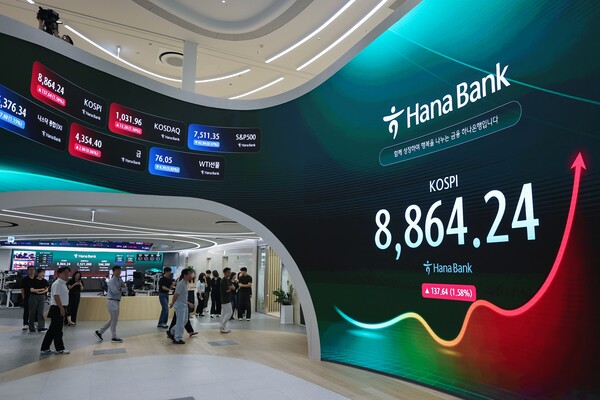
[DigitalToday reporter Oh Sang-yeop] The KOSPI on Tuesday erased early weakness and turned higher, finishing near the 8,860 level and setting an all-time high on a closing basis. Expectations of an improved macro environment continued, including downward pressure on oil prices following the start of a U.S.-Iran ceasefire and a calming surge in the won-dollar exchange rate. The KOSDAQ also ended up more than 1 percent.
The KOSPI ended up 137.64 points, or 1.58 percent, at 8,864.24 from the previous session. The index opened at 8,622.13, down 104.47 points, or 1.20 percent, but turned higher during the session.
The KOSPI rose above the 8,870 level intraday, approaching its 52-week high of 8,933.62. With sharp swings persisting recently, buying flowed into semiconductor shares and some top market-cap stocks, widening the index's gains.
Individuals and institutions supported flows. On the main board, individuals were net buyers of 543.1 billion won and institutions bought a net 577.7 billion won. Foreigners, by contrast, were net sellers of 993.1 billion won for the first time in three sessions.
Top market-cap stocks were stronger, led by semiconductor shares. Samsung Electronics closed at 346,500 won, up 3,500 won, or 1.02 percent, from the previous session. SK Hynix ended at 2,521,000 won, up 139,000 won, or 5.84 percent.
Elsewhere, SK Square gained 6.33 percent. LG Energy Solution rose 1.34 percent, Samsung Life 3.71 percent and HD Hyundai Heavy Industries 1.29 percent.
Samsung Electro-Mechanics fell 0.78 percent, Hyundai Motor dropped 3.44 percent and Samsung C&T lost 1.41 percent.
The KOSDAQ also rose. The KOSDAQ ended up 13.28 points, or 1.30 percent, at 1,031.96 from the previous session. The index was weak early but later rebounded to reclaim the 1,030 level.
In the Seoul foreign exchange market, the won was quoted at 1,512.70 per U.S. dollar, 1.70 won weaker than the previous session.
Han Ji-young (한지영), a researcher at Kiwoom Securities, explained that the main reasons behind foreigners' net selling over the past month were concentrated profit-taking in semiconductors and mechanical rebalancing of the weighting of South Korean equities within emerging markets, while macro uncertainty also provided an additional incentive for net selling.
Han said that unless the June Federal Open Market Committee meeting ends with shock-level hawkishness, the likelihood of macro burdens intensifying further does not appear high. He said it would be appropriate to reflect in response strategies the point that foreigners' flow conditions could improve compared with before.
 Oh Sang-yeop
yub@d-today.co.kr
Oh Sang-yeop
yub@d-today.co.kr