
South Korea's Institute for Information & Communications Technology Planning & Evaluation (IITP) is moving to strengthen full-stack competitiveness by linking key technologies including AI semiconductors, physical AI and next-generation networks. It is responding to the era of 'AI transformation (AX) 2.0', in which agentic AI and physical AI spread to industrial sites. It is also speeding efforts to connect private-sector AI technology with military demand to expand defence AX and foster a 'K-Palantir.'
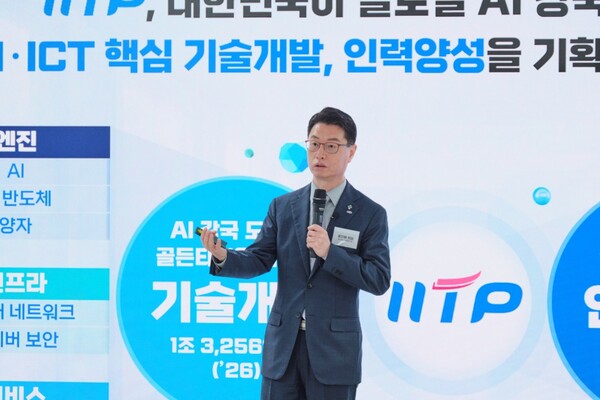
IITP held its 2026 Performance Media Day on Tuesday at the AI & SW Maestro Training Center in Mapo-gu, Seoul, and announced results in AI and ICT R&D and talent development as well as future business directions.
IITP, an R&D management agency under the Ministry of Science and ICT, supports projects worth a total of 1.9 trillion won this year. That includes 1.14 trillion won for technology development, 574.0 billion won for talent development and 170.6 billion won for foundation building and technology commercialisation.
On the day, IITP President Hong Jin-bae (홍진배) presented AI semiconductors, AI models, physical AI, next-generation networks, cybersecurity and the spread of AX as key sovereign technologies. He explained that beyond performance competition by individual technology, full-stack capabilities linking semiconductors, networks, models and services will determine national AI competitiveness.
◆Spread of agentic and physical AI... AX 2.0 gathers pace
IITP assessed that the AX 2.0 era is taking hold as AI expands beyond digital space into physical environments such as manufacturing, robots and autonomous driving. It also analysed that the talent capabilities demanded by industry are shifting to problem definition, AI convergence and redesign, and the ability to integrate multiple AI systems.
Hong said securing key sovereign technologies at the national level is essential. He said AX 2.0 competition will expand beyond competition in individual technologies into full-stack competition spanning AI models, physical AI, AI semiconductors, networks and cybersecurity.
IITP is focusing on supporting full-stack technology to prepare for the AX 2.0 era. In AI semiconductors, it has supported technology development for next-generation intelligent semiconductors and processing-in-memory (PIM) semiconductors since 2020, laying a growth foundation for domestic AI semiconductor companies including FuriosaAI, Rebellions, DeepX and Mobilint.
Through the K-Cloud technology development project, it is supporting efforts to secure next-generation AI computing technologies such as data processing units (DPUs) and compute express link (CXL). MangoBoost recorded higher price-to-performance than Nvidia's H100 with DPU technology linked to AMD's MI300X GPU. In AI models, it supported development of an ultra-light multimodal vision-language model (VLM), starting with 'Exobrain', the country's first AI R&D project. Related investment led to growth at domestic AI companies including Saltlux, Konan Technology, MAUM AI and NC AI.
This year, the Ministry of Science and ICT and IITP will launch development of four agentic AI projects aimed at public-facing benefits, supporting enterprise-wide work innovation and simulation design assistance, counselling and medical ultrasound analysis. They will also develop agentic AI platform technology that understands user goals and supports task execution. In physical AI, they will pursue acquisition of autonomous intelligence platforms, humanoid mass production systems and edge AI semiconductor technologies. They will support development of core physical AI technologies through general-purpose foundation models and world models.
◆Strengthening 6G, satellite communications and cybersecurity... spread of defence AI
IITP supported domestic companies including Solid and EO Solutions in entering global telecom equipment and parts supply chains through 5G and Open RAN R&D investment. It will invest 300.4 billion won in low-orbit satellite communications technology development from 2025 to 2030. It will also prepare for early commercialisation of 6G through a domestic 6G integrated demonstration in 2028. In 2030, it plans to launch a 6G low-orbit satellite and link terrestrial and satellite networks.
In cybersecurity, it is advancing security systems centred on zero trust, software supply chains and cloud deep defence technologies. Many domestic companies are localising AI system-on-chip (SoC) for intelligent closed-circuit (CC)TV and expanding cooperation with global security companies. It is also pushing an 'AI Cyber Shield Dome' to bring technologies together around a security-focused AI engine to respond to autonomous AI attacks.
Hong stressed the potential of South Korea's cybersecurity technology. He said the U.S. intelligent CCTV market offers greater opportunity for South Korean companies because of the impact of relations with China. He also said domestic homomorphic encryption technology is in first place with a wide gap over second place.
IITP is also focusing on AX expansion projects that apply AI and ICT R&D results to defence, the public sector and industrial sites. In defence, it is 추진 a defence pilot programme that links private-sector AI technology with military demand and an 'AX Sprint'. It will build military-industry-academia cooperation centres at five hubs nationwide in Daejeon, Yongsan, Yangjae, Busan and Pangyo to provide test environments and data safe zones.
In the public sector, it is applying AI technology to public safety issues including deepfakes, illegal filming materials, missing persons and suicide. The deepfake detection technology 'Aegis' was used to block about 35,000 harmful deepfakes during the 2025 presidential election and the 2026 local elections. Real-time detection technology for illegal filming materials was applied to 26 major platforms including Naver and TikTok. Three-dimensional precision positioning technology for emergency rescue was expanded to 31 police stations in Seoul and used in about 2,000 cases related to missing persons and suicide.
Hong said it would expand the scope of defence AX applications and the operating areas of the military-industry-academia hub centres, and foster a K-Palantir through a defence AI strategic project.
◆Strengthening AI talent development... securing top-tier, converged and practical talent
In AI and ICT talent development, IITP aims to build a multi-layered system spanning top-tier research talent to practical talent. Hong said talent in the top 1 percent that can lead the market is important. He said it plans to expand support for top-level early-career researchers, AX graduate schools and software-centred universities.
This year, it will newly select 10 AI-centred universities and 10 AX graduate schools. It will also nurture research talent through university ICT research centres and an AI early-career researcher support programme. It will expand regional AI and software education through 42 software-centred universities and 17 regional intelligent innovation talent development projects. The goal is to reduce young talent leaving for the Seoul metropolitan area and promote regional AX transformation by supporting joint R&D and commercialisation between regional universities and companies.
Hong said he hopes to keep training more talent and expects the trained talent to help regional AX.
 Jin-ho Lee
jhlee26@d-today.co.kr
Jin-ho Lee
jhlee26@d-today.co.kr