
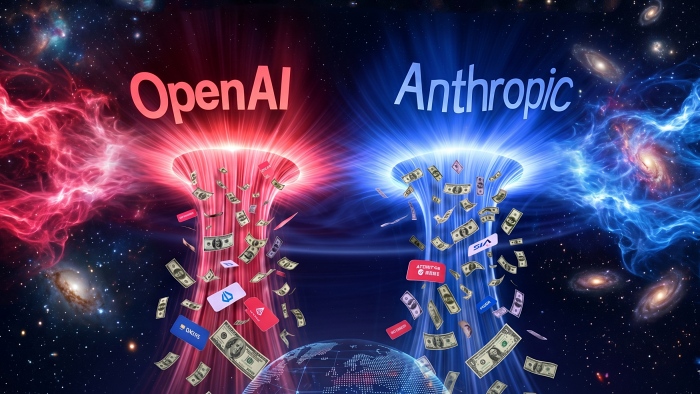
As AI model developers rapidly expand beyond models into AI applications, scenes are increasingly playing out in which relationships with companies that had been partners become delicate.
Anthropic’s recent moves have become a sensitive issue. The Information reported that after Anthropic recently unveiled the Fable5 model based on Mythos, it said it would reduce the model’s performance without notice if it was used to develop its own AI models or hardware, and a sense of crisis appears to be growing among Anthropic customers.
After pushback, Anthropic stepped back, saying it would notify customers before lowering performance. Some concerns persist.
Anthropic’s measure could make it harder for hostile foreign countries or rival AI companies to use its models to improve model performance. It has also raised concerns that it could restrict even basic functions developers need to build AI applications.
Such concerns did not arise suddenly, but have been growing since Anthropic introduced Claude Code, a coding AI tool, in February last year. Some investors are also warning that Anthropic could restrict some cutting-edge technologies in its models to develop its own applications.
Martin Casado (마틴 카사도), a general partner at prominent Silicon Valley venture capital firm Andreessen Horowitz, said on social media platform X (Twitter) in April, "It is only a matter of time before the best-performing AI models are ultimately used only by the developers," and "the rest of the companies will only get to use lighter, distilled versions models with lower performance."
Moves to expand beyond models into applications have also emerged as a variable in Anthropic’s partnerships.
The Information reported that a few weeks before Anthropic unveiled Claude Design, which supports design generation and prototyping software applications, it also asked design software companies Canva and Figma to become partners. Both companies initially saw Claude Design as complementary to their products, but reality was different. In practice, it was closer to a competing product than a complementary one.
Days before the launch of Claude Design, Figma withdrew from the negotiating table, and around the same time Anthropic Chief Product Officer Mike Krieger (마이크 크리거) left Figma’s board, The Information reported. The Information added that this was because Anthropic changed its launch plans so the Claude Design product could compete more with products sold by Figma and Canva.
Anthropic and OpenAI are developing their own applications based on their models, to a level that threatens even large companies, including Microsoft, that use their model APIs.
The two companies have recently positioned themselves as core suppliers of enterprise AI and are accelerating efforts to help companies automate office work across various software applications, including Microsoft.
In broad terms, it is a similar scene to Microsoft and Google expanding into service areas based on core platforms of Windows OS and search, respectively, and creating big and small tensions.
It is not at the level seen when Microsoft and Google were embroiled in antitrust controversy, but it is true that more stakeholders are uncomfortable with the situation in which power is concentrating in the two companies.
The Information reported that as many startups and established tech companies realize major AI providers may try to take their market share, they are publicly criticizing them. Figma CEO Dylan Field said at a closed event hosted by Sequoia Capital that Anthropic "was not consistently honest in its communication process" over Claude Design.
 Chi-gyu Hwang
delight@d-today.co.kr
Chi-gyu Hwang
delight@d-today.co.kr