
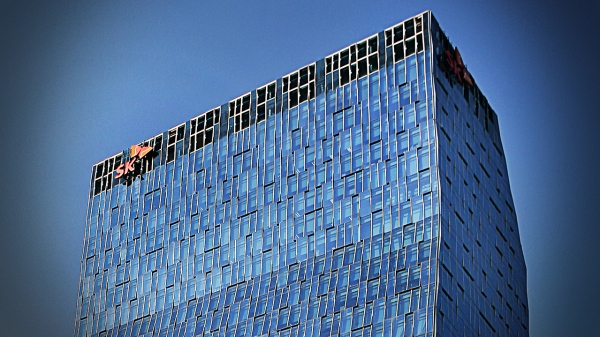
SK Telecom is joining hands with Nvidia to accelerate its push into the artificial intelligence (AI) infrastructure market. It plans to expand an “AI factory” specialised for AI work to gigawatt-scale capacity based on Nvidia’s platform.
SK Telecom said Choi Tae-won (최태원), chairman of SK Group, and Jensen Huang (젠슨 황), Nvidia’s chief executive officer, met in Taiwan early this month to review an AI infrastructure roadmap and agreed to pursue group-level cooperation. Choi also met Huang again on June 5, 7 and 8, when Huang visited South Korea, and reaffirmed their willingness to cooperate.
Inference demand and power consumption surge...AI factory to absorb infrastructure demand
The core of the cooperation is the AI factory. An AI factory refers to a data centre that uses electricity and data as inputs to produce “tokens,” the core unit of AI. The concept was first presented in the 2020 book “Competing in the Age of AI” by Harvard Business School professors Marco Iansiti and Karim R. Lakhani. It has since become familiar in the industry as Huang has stressed AI factories as next-generation industrial infrastructure at official events.
SK Telecom is the main executor of the cooperation. It plans to run an AI factory next year based on Nvidia’s DSX platform. Unlike conventional data centres focused on general-purpose computing and data storage, an AI factory is specialised for AI model training and inference and large-scale data processing. SK Telecom aims to combine the data centre operating capabilities of its subsidiary SK Broadband with Nvidia’s graphics processing units (GPUs), networks and software to leap into a leading AI cloud operator in Asia.
The cooperation also aligns with a shift in the AI industry’s focus from training to inference. Deloitte forecasts that in 2026, inference demand to run AI models in real services will account for about two-thirds of global AI computing resources. SK Telecom plans to use AI factories to absorb rapidly rising domestic demand for AI inference infrastructure and later expand infrastructure to gigawatt scale to broaden its business across Asia.
An AI industry official said, “Once gigawatt-scale infrastructure is completed, SK Telecom can rise to become the largest AI infrastructure operator in South Korea,” adding, “It will accelerate the shift beyond telecommunications to a full AI company.”
SK Telecom is confident it can achieve this with an AI full stack. AI full stack refers to capabilities spanning all technologies needed to implement AI, from semiconductors and networking to data centres, cloud and AI models and services.
SK Telecom has already had its technological capabilities recognised through multiple solutions. At the Gasan AI data centre, it operates the GPU-as-a-service (GPUaaS) cluster “Haein.” Haein, built with more than 1,000 Nvidia Blackwell B200 GPUs, won a GSMA Global Mobile Award this year. It also has its own AI model capabilities, including “A.X K1,” developed through the government-led sovereign foundation model project.
From chips to operations, building a full stack...token production efficiency is the edge
Cooperation with Nvidia is expected to become an opportunity for SK Telecom to grow into an operator that designs and runs the broader AI cloud. Building an AI factory requires organic integration of not only GPUs, but also high-speed networks and storage, power, cooling facilities and operating software.
Synergies at the SK Group level are also expected. Combining SK Hynix’s high-bandwidth memory (HBM), SK Broadband’s data centres and SK Telecom’s AI cloud and model capabilities could build an AI value chain from semiconductors to infrastructure operations and services. When the Ulsan AI data centre being built in cooperation with Amazon Web Services (AWS) and the southwest region AI data centre being developed in cooperation with OpenAI start operating, SK Group’s capabilities to build and run AI infrastructure are expected to strengthen further.
Still, building a gigawatt-scale AI factory requires securing a stable power supply and easing the burden of large investment costs. With the rapid release of the latest GPUs, the burden of equipment replacement and depreciation is also significant. Securing enough customers after construction to maintain a high utilisation rate is another task.
An industry official said, “For AI data centres, it is more important to secure power and customer demand stably than to build facilities,” adding, “Whether it can attract AI infrastructure demand from global companies and at the national level, rather than staying in the domestic market, will determine business success or failure.”
 Jin-ho Lee
jhlee26@d-today.co.kr
Jin-ho Lee
jhlee26@d-today.co.kr