
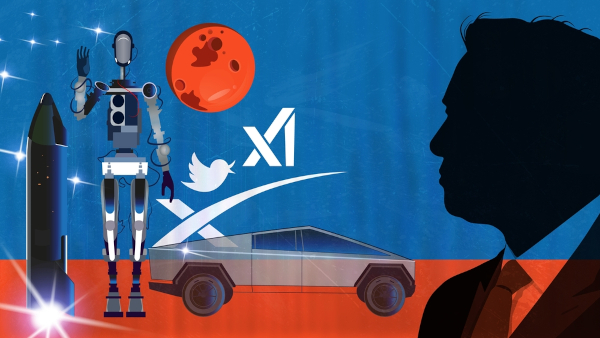
SpaceX and Tesla, led by Elon Musk, are again drawing attention over the possibility of a merger.
Interest in synergies between the two companies and scenarios for integrating their businesses is growing after SpaceX President Gwynne Shotwell mentioned the possibility. The market is watching whether a vast ecosystem spanning space, AI and mobility could become reality.
SpaceX President Gwynne Shotwell mentions possibility of a merger with Tesla.
Tesla's autonomous driving technology is entering a phase of European expansion and performance verification. Full Self-Driving has expanded to four European countries, and Denmark, which had previously taken a cautious stance, has secured conditional approval, widening the scope of deployment.
On Wall Street in the United States, some assessments are emerging that Tesla has effectively come close to Level 4 autonomous driving, based on insurance premium data. Expectations around FSD are rising again.
Tesla FSD tops four European countries; Denmark, which had opposed it, grants conditional approval. U.S. Wall Street: "Tesla has effectively achieved Level 4 autonomous driving"; insurance premiums as evidence?
The outline of Tesla's robotaxi and autonomous driving technology is gradually taking shape. As key specifications for the Cybercab are disclosed and interest in vehicle performance grows, the latest FSD V14 is expanding automation from departure to parking, accelerating advances in autonomous driving.
Map accuracy and responses to local driving environments remain challenges. How much the gap between technological evolution and commercialisation can be narrowed is seen as key. Cases have also emerged in which the autonomous driving monitoring system is fooled by simple workarounds, adding to criticism that safety and reliability remain important tasks apart from technological progress.
Tesla Cybercab unveiled; EPA document confirms 1,400 kg ultra-lightweight and 470 km range. Tesla FSD V14 on HW4 automates from departure to parking; map accuracy remains a task. Tesla safety device breached again; FSD monitoring system fooled by a 40,000 won "doll head".
BYD's rapid run continued this week. It declared it would become the world's No. 1 automaker within five years on the back of growth that has surpassed Tesla, while also accelerating the expansion of ultra-fast charging infrastructure. It is strengthening its global market push by emphasising sales volume and technology.
It also is showcasing its technological competitiveness by achieving 97 percent charging in 9 minutes and launching 1,500 kW flash-charging services in Europe and Britain. BYD's all-front push spanning sales, charging and infrastructure appears to be gaining momentum.
BYD that beat Tesla targets Toyota next: "World No. 1 within 5 years". Technology that could put Tesla on edge; BYD succeeds in charging to 97 percent in 9 minutes. BYD launches 1,500 kW flash charging in Europe and Britain; lower fees than Tesla.
Xiaomi has also joined the competition in EV charging automation technology. The robot-type charger unveiled by the company can automatically recognise a vehicle and start charging without driver operation, and automatically disconnect the cable when the battery charge reaches a set level.
Xiaomi unveils EV automatic charging robot; sales planned within the year.
An analysis found that the wider adoption of electric vehicles in China is having tangible effects on the environment and public health. As more EVs replace internal combustion engine vehicles, concentrations of ultrafine dust fell sharply, and it was assessed to have led to social benefits such as fewer premature deaths.
China's ultrafine dust falls 23 percent on EV spread; prevented 260,000 premature deaths.
In South Korea, a service has also emerged to reduce the charging burden of long-distance EV travel. Bright Energy Partners, which operates the fast-charging network Water, said it launched the highway charging-station search and recommendation service Water Express in the Water app.
Water launches highway charging-station search and recommendation service.
The electric bicycle market is entering full-scale competition in high performance and high output. A series of new products, from models capable of high-speed riding to electric mountain bikes aimed at off-road and camping use, and electric road bikes with powerful motors, have drawn market attention.
As more products boost both driving performance and range of use, electric bicycles are rapidly expanding beyond simple transport into leisure and sports.
"Fast and convenient"; Gazelle unveils two 45 km per hour-class electric bicycles with new Bosch motors. Carry camping gear and ride mountain paths; Specialized unveils new electric bicycle 'Turbo Levo 4 X'. Monster output motor hits the road; Megamo launches an electric road bike based on Avinox.
 Jinju Hong
hongjj@d-today.co.kr
Jinju Hong
hongjj@d-today.co.kr