
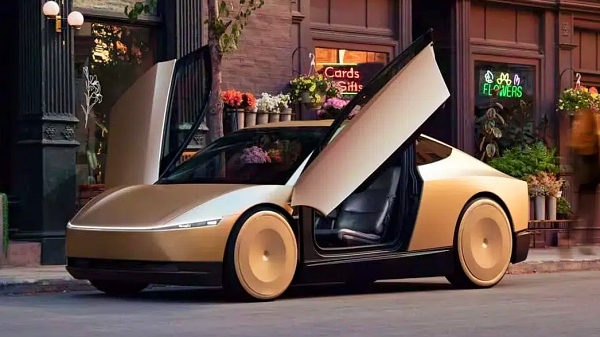
[DigitalToday reporter Hyunwoo Choo (추현우)] Detailed specifications for Tesla’s two-seat self-driving robotaxi Cybercab were officially confirmed through U.S. Environmental Protection Agency (EPA) certification documents. Tesla applied to the EPA for a Certificate of Conformity on May 12 this year and received final certification on May 26.
According to the certification documents (test group TTSLV00.0L1A), the Cybercab has a 326V, 47.6 kWh battery and a 163 kW (219 horsepower) AC permanent-magnet motor. Its curb weight is 1,412 kg, about 340 kg lighter than the Tesla Model 3. It uses front-wheel drive (FWD), an unusual choice that differs from Tesla’s existing lineup, which focuses on rear-wheel or all-wheel drive. This is seen as a design aimed at reducing costs and weight.
Its EPA laboratory combined driving range is 673 km, and the highway figure is 604 km. Under real-world driving, it is expected to be about 470 km. Average efficiency is 10.4 km per kWh, the highest ever among EVs certified by the EPA.
A full charge requires 53.365 kWh on a 208V Level 2 basis, meaning about 12 percent is lost in charging compared with the battery capacity of 47.6 kWh. It was also confirmed that all emissions substances, including carbon, nitrogen oxides and fine dust, are completely zero over the full 240,000 km service-life period. It meets both the EPA’s top rating, Tier 3 Bin 0, and California ZEV standards, and also obtained the federal Inherently Low Emission Vehicle (ILEV) rating.
Testing was conducted on a vehicle in real use that had already traveled 3,475 km as of April 20 this year. That means these figures came even using a vehicle with driving history rather than a new car. Regenerative braking was applied electrically to the front wheels.
The issue is not the specs but usefulness. An analysis is gaining ground that even if robotaxis can encroach on the ride-hailing market such as taxis and Uber, it will be difficult for them to replace the broader private passenger car market.
Costs are particularly central. In the United States, the operating cost for a privately owned gasoline vehicle bought new and driven for 5 years is about $0.47 to $0.62 per km. Robotaxi operators, by contrast, would need to charge more than $0.50 per km when company overhead is added even if they lower operating costs to $0.25 per km. The point is that even excluding driver labor, there is little incentive to give up a private car. Even internal Tesla research concluded that the robotaxi business is not attractive in terms of profitability, and Elon Musk is reported to have rejected that.
Convenience is also a hard barrier to overcome. A private car can leave immediately when the owner wants, but a robotaxi requires waiting for it to arrive after being summoned. If the extra driving of traveling empty accumulates as costs, then no matter how good efficiency is, it ultimately becomes more expensive than a private car. There is also a paradox that if self-driving becomes widespread it becomes easier to share one car across households, which further reduces reasons to switch to robotaxis.
Experts expect robotaxis in the United States to remain at fewer than 50,000 units a year. They say that no matter how strong the specs are, the market landscape will not change unless it simultaneously overcomes three barriers: cost, convenience and traffic congestion.
The Cybercab has been officially proven to be the most efficient EV ever certified by the EPA. But the structural contradiction remains unresolved: even the most efficient robotaxi has to drive more than a privately owned car to provide the same service. What Tesla really needs to prove is not battery capacity or driving range, but a business model that makes people put down their car keys.
 Hyunwoo Choo
cookinpapa@d-today.co.kr
Hyunwoo Choo
cookinpapa@d-today.co.kr