
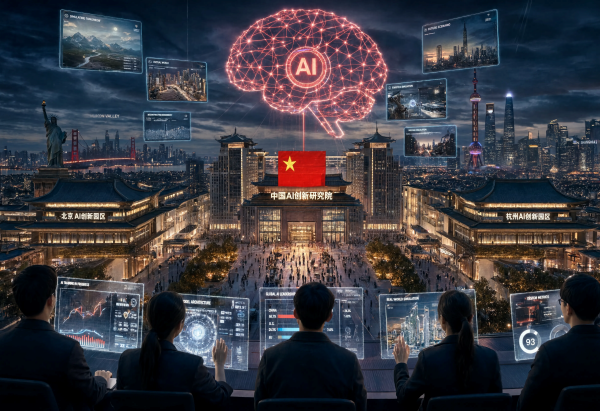
[DigitalToday reporter Jinju Hong (홍진주)] An assessment has emerged that China is ahead of the United States in the field of “world models” (World Model), seen as the next battleground for generative AI.
On June 16 (local time), Hong Kong’s South China Morning Post (SMCP) said Chinese companies are expanding their presence in the field on the back of real-world training data needed for robotics and autonomous driving, application sites and government support.
World models are a technology designed to make AI understand and predict how the physical world works. They go beyond existing generative AI that stayed at generating text or images. The focus is on enabling machines to learn space and movement, and cause and effect, and translate that learning into real actions. The industry sees the technology as a key factor that will determine performance in humanoid robots, self-driving cars and industrial automation.
Chinese companies are already moving with this area as a core pillar of next-generation AI competition. Some companies are working to advance their models using real road-driving data and data from factories, logistics and service sites. China’s strength is cited as its ability to collect physical-world data on a large scale and connect it to training and validation.
Industry figures related to the field see the United States as leading in the competition for large language models (LLMs), but view world models as a different contest. One expert assessed the technology as “not simply the next stage of generative AI, but the foundation for AI to interact with the real world.” Another industry official said China’s manufacturing base and real application scenarios are advantageous for world model training.
This trend also aligns with China’s expanding investment in robotics. Humanoid robots and autonomous driving require far more real-world validation than text-based AI. Companies that can reliably secure data generated in the operation of sensors, cameras, vehicles and robots therefore have an advantage. Chinese companies are assessed as having relatively broad test environments in this respect.
The market view is that world models are still at an early stage, but their commercialisation impact may be comparable to that of LLMs. The technology is directly linked to robots planning actions in new spaces or autonomous driving systems predicting complex road situations. One researcher emphasised the importance of real-environment data, saying, “Internet data alone cannot sufficiently understand the real world.”
U.S. big tech has also entered the field, but China appears to be seeking competitiveness in its data accumulation structure and the speed of experiments in industrial sites. World models require not only massive computing power but also long-term on-site collection and repeated validation. This has also highlighted that it is a field where it is difficult to determine an edge based on semiconductor performance competition alone.
Still, the technology gap is not settled. World models are at a stage where concept definition and commercial application are proceeding at the same time. Questions also remain over model generality, safety and cost. Even so, the industry is paying attention to the possibility that the technology could become a turning point in expanding AI from on-screen services to real-world machine control.
In this situation, an analysis is gaining traction that China’s strength lies less in the AI models themselves than in the industrial structure that can test and improve them. If generative AI competition centred on data centres and semiconductors, world model competition is likely to unfold as an arrangement in which the entire real world space — including factories, roads, robots and logistics networks — becomes a training ground. A key point to watch will be whether Chinese companies can translate this edge into performance in actual robots and autonomous driving services.
 Jinju Hong
hongjj@d-today.co.kr
Jinju Hong
hongjj@d-today.co.kr