
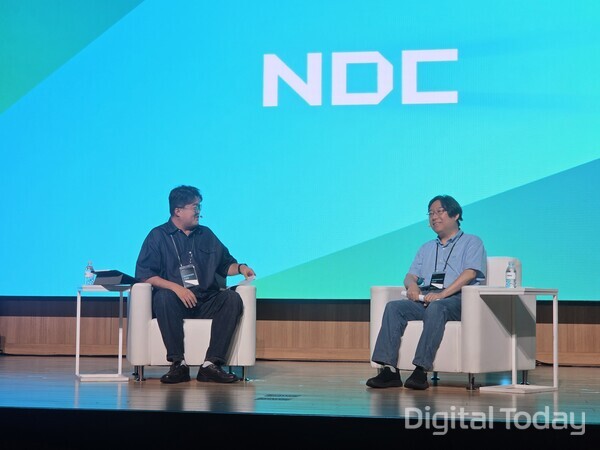
Park Yong-hyun (박용현), CEO of Nexon Games, said on Monday at a dialogue session at the 2026 Nexon Developer Conference (NDC 26) that developing multiple game genres at the same time was not an intentional strategy from the outset but a practical choice rooted in structural features of South Korea's online game industry.
The theme of the discussion was “Developing different games at the same time.” Park, speaking from his experience as both a gamer and a developer, shared why Nexon Games is running 4 live games and 5 new projects in parallel and how it turns experience accumulated in the process into competitiveness.
“Not intended diversification” ... a reality shaped by South Korea’s online game structure
Park said the background to developing diverse genres simultaneously lies in the structure of South Korea’s game industry. Overseas packaged-game developers can disband teams after a title launches and immediately shift staff to new projects, but South Korea grew on online games, so the entire development workforce remains tied to live service even after launch.
“A company that has a game that lasts 10 or 20 years survives, but a company that does not disappears within 10 years,” he said. “From the perspective of a CEO at a company that did not achieve that level of success, we ended up in the current state as we struggled to survive more than 10 years,” he added. It means the result was an accumulation of choices made for survival, not diversification designed from the start.
He said genre expansion followed the same logic. Rebuilding a game similar to an existing service creates internal competition, and because the core workforce is RPG-based, the company expanded by exploring other elements while keeping a foot in RPGs rather than moving to completely new genres. “Even if our games involve shooting guns or a subculture style, the core is closer to an RPG,” Park said. “From the outside, it may look like a variety of genres, but on the inside we do not feel we are making such high-risk choices,” he added.
He said the market structure also supports this direction. “Looking at user needs these days, only the two extremes have opportunities left: either a mega-sized game that has everything, or a game that firmly captures one part users want,” he said. “In-between, it has become the hardest situation for lukewarm games to survive,” he added. He said big games carry a heavy development cost burden and narrowly focused high-risk titles make it hard to ensure stable company operations, so running multiple titles in parallel becomes a practical balance point.
On the subculture market, he said it is becoming difficult for mid-sized Korean and Japanese games to survive as Chinese games push in at scale. He said only the extremes have opportunities left: either breaking through at China-level quality, or narrowing user targeting very tightly.
From earlier projects to later ones ... transferring experience is the core of parallel development
Park said the most important thing in running multiple projects at the same time is transferring experience between projects. “When each project runs in parallel, the difficulties you end up experiencing are not that different,” he said. “If you see a team face and solve a difficulty, you carry that experience over to other projects,” he added. He said problems that arise in earlier projects tend to recur in other projects with a time lag, so warning in advance or sharing solutions can reduce repeated trial and error.
As a real example, he cited the development process for “Blue Archive.” He said that when serving the mobile RPG “Overhit,” which launched before Blue Archive, in Japan, the company invested far more money and effort than typical localisation, and that experience helped it understand and accept the subculture-game-specific requirements requested by producer Kim Yong-ha during Blue Archive’s early development. “By the standards of the time, they were requirements that made you wonder if it was really okay,” Park said. “But because we had the Overhit experience, we could understand and accept the request. In this way, experiences keep connecting,” he added.
From this perspective, Park said he partly agreed with concerns that experience is lost when employees leave, but added that “it is also true that some of it remains in the company.” He said there is an unavoidable difference in the speed of adapting to market trends between a company that services one game for 5 to 6 years before ending it and starting a new game, and a company that makes games one by one in between.
The CEO’s role is direction-setting and troubleshooting ... game content is the authority of PDs and directors
Park said that while he oversees 9 projects, he does not get involved in the specific content of each game. He said he provides guidance on which market to enter, at what scale and at what quality level, and intervenes in troubleshooting only when problems arise during progress. He said the substance, such as quest structure and story, is delegated to PDs and directors.
“The ones making the game are the PDs and directors, not me,” he said, stressing that “maintaining that distinction is the most important thing.” On allocating shared resources, he said, “If you pursue manpower efficiency too aggressively, conflict actually grows in real game production,” adding that “it is better to have each development team operate relatively independently, even if it is a slight loss in efficiency.”
For projects close to launch, he said he sits directly with the team to grasp the situation. He said this is to handle immediately issues that are difficult to decide at the PD level, such as platform, publishing and marketing, while being on the ground instead of receiving information through reporting lines. He also holds separate meetings once a week for all projects.
“The next task is long-term service” ... so far, a repeated drop after early success
Park said Nexon Games has been able to get games to settle in the market to some extent, but still lacks the capability to carry that into long-term service. He said the pattern has repeated of indicators breaking after 1 year to 1.5 years following early success. Blue Archive became an exceptional case as it passed its fifth year of service, but he said the next task is to make that a repeatable structure.
“I think we have done fairly well up to breaking into the market, but I am feeling that servicing together with users for a long time after launch requires another kind of know-how,” he said.
Park said developing multiple projects at the same time is not simply expanding the lineup, but a process of leaving each project’s trial and error as company experience and reflecting it in the next project. He said he expected that if new projects begin to deliver results sequentially from the end of this year, this experience-accumulation structure would become clearer.
 Lee Ho-jung
lhj@d-today.co.kr
Lee Ho-jung
lhj@d-today.co.kr