
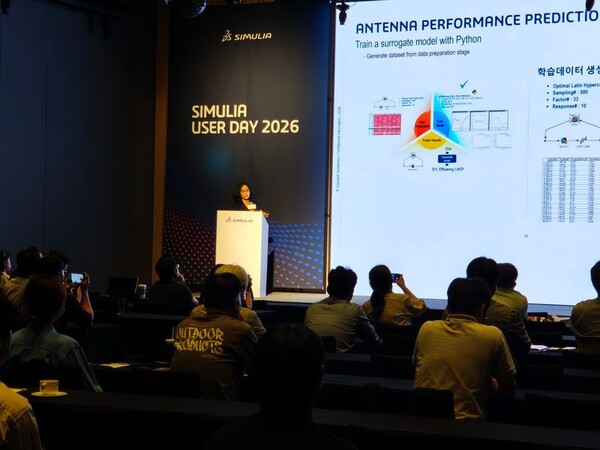
A view of the Simulia User Day conference hosted by Dassault Systemes Korea on June 11.
Cases applying AI to manufacturing engineering, where a perception remains that it is difficult to see results from AI, drew attention. Officials from major domestic manufacturers such as Samsung Electronics and LG Electronics appeared in person to share cases combining AI with engineering.
Yong-seon Shin (신용선), a professional in Samsung Electronics' Industry Cooperation Team, presented a case of antenna performance prediction technology using machine-learning algorithms. He stressed that AI can be used in engineering areas such as antenna design.
Shin, who has worked only in antenna development for more than 20 years, said he had believed that even if AI improved, applying machine learning to antenna design did not have major advantages from an engineering perspective. He said there were reasons for that.
First, antenna performance is heavily affected not only by the antenna's own structure but also by the structure around the vehicle or device in which it is mounted, and by complex changes in media. There is also no big data essential for training AI models.
Even if simulation data are secured with a finite element method (FEM) solver, it takes a lot of time and cost. Because the correlation between input design variables and output results shows high-dimensional nonlinear movement, it is not easy to model a prediction model with mathematical modeling.
Against that backdrop, Shin said he changed his mind in March last year while carrying out an antenna AI model development project, and came to believe AI could also be used in antenna development.
He said, "I didn't know coding languages or how to build datasets. With help from Dassault Systemes, I set up a proof-of-concept (PoC) project and built an analysis automation process in virtual space to directly demonstrate the feasibility of applying AI."
According to Shin, the project's results can be summarised as follows. In terms of work efficiency, it significantly reduced the CST analysis process that had been repeatedly run hundreds of times. It also selected only candidate designs with a high likelihood of meeting specifications at the initial design stage, shortening development lead time by dozens of times. In terms of technology application, it proved that it is possible to build a reliable predictive metamodel even with a limited dataset.
Shin said he plans to expand the scope beyond a single antenna module to LTE and Wi-Fi complex multi-band antennas, and build a company-wide standard design verification infrastructure that includes shape variables such as body chassis structure, glass and bracket position. He said, "If engineers control an AI pipeline with clear design objectives and domain knowledge, it can be used as a strategic engineering tool that eliminates repetitive tuning and analysis time and accelerates key design decision-making."
Sang-hyuk Choi (최상혁), a senior researcher at LG Electronics' Production Technology Institute, presented a method for building an SPDM CAE database using AI agents.
LG Electronics began a pilot of an SPDM (Simulation Process and Data Management) platform based on Dassault Systemes solutions at the end of 2019. It completed a headquarters rollout in April 2022. In the first 2 to 3 years, a problem was that working-level engineers were reluctant to use the system because CAE organisations in each business division were scattered. LG Electronics therefore pushed a task to advance report files that remained a simple data lake into a quantitative numerical database.
The direction was not to change how engineers work. It focused on having the system automatically extract figures and turn them into a database when users upload only PowerPoint reports, as in existing practice.
A problem faced during the project was that a general large language model level could not precisely read tables and object data in complex PowerPoint files. To overcome this, it introduced the vision language model Qwen3-VL, which simultaneously analyses visual information, and built a four-stage data extraction process. The constructed database is used in the field for outlier analysis, design pattern analysis and trend analysis.
Choi cited as a key achievement that the project built a system that converts unstructured report data into structured assets without changing how working-level engineers work. He said, "Breaking the limitations of the existing method that required directly entering figures, we maximised database accessibility and convenience with an AI agent pipeline that guarantees 100 percent autonomy for the field," adding, "We completed the foundation of a data pipeline that can provide high-quality engineering nutrients to AI models."
 Chi-gyu Hwang
delight@d-today.co.kr
Chi-gyu Hwang
delight@d-today.co.kr