
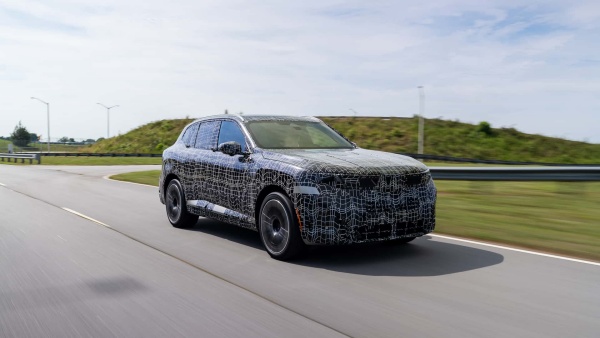
BMW will fit a 144 kWh-class high-capacity battery to its iX5 electric SUV, set for release this summer. It would be the largest battery among BMW electric vehicles. BMW is aiming at the premium electric SUV market by emphasizing long-range driving performance.
InsideEVs, an electric-vehicle specialist outlet, reported on June 15 that the U.S.-spec BMW iX5 xDrive60 will use a 144 kWh battery on a usable-capacity basis. The European model is about 141 kWh. This is the largest battery capacity among BMW electric vehicles currently on sale.
BMW has not yet disclosed an official driving range, but the industry sees the iX5 as a new competitor in the long-range electric SUV market.
BMW has previously said its next-generation electric iX3 and i3 sedan will carry a 112 kWh battery and target a driving range of more than 400 miles, or about 644 km, under U.S. Environmental Protection Agency standards. That has led to expectations that the iX5, with a larger battery, will also have long-range capability.
On battery size alone, it tops competing models. The Porsche Cayenne Electric is known to be equipped with about a 113 kWh battery, while the Lucid Gravity Grand Touring uses a 123 kWh battery. Rivian's R1S Max Pack has usable capacity of about 140 kWh, closest to the iX5.
It is smaller than batteries of more than 200 kWh used in large electric trucks and SUVs such as the Chevrolet Silverado EV, GMC Hummer EV and Cadillac Escalade IQ.
A high-capacity battery offers long-range driving but also brings the challenge of added weight. Autocar, a British automotive outlet, forecast the iX5 curb weight at about 3,000 kg, or 6,600 pounds. That would be a very heavy level even among electric SUVs.
As added weight can affect energy efficiency, ride comfort and handling, BMW has focused on improving the body and chassis structure. BMW changed the suspension design by separating the springs and dampers and increasing the air-chamber volume. It designed the system to secure sufficient suspension stroke even under heavy loads. It also adjusted the placement of adaptive dampers and anti-roll bars, focusing on balancing ride comfort and driving stability.
The battery system also applies the latest lightweighting technology. The iX5 uses cell-to-pack technology introduced on BMW's next-generation EV platform, Neue Klasse. The approach boosts energy density and reduces weight by minimizing battery modules and structural parts. BMW engineers explained they adjusted floor height in millimeter increments to keep interior space and body proportions while fitting the large battery.
The platform configuration is somewhat unusual. The iX5 uses a cluster architecture that modifies an internal-combustion-based platform for EV use. By contrast, BMW's next-generation electric iX3 applies Neue Klasse as a dedicated EV platform. Even so, the iX5 will actively adopt core Neue Klasse technologies. Key examples include BMW's sixth-generation cylindrical battery cells and an 800-volt electrical architecture. This is seen as a strategy to combine proven structures of the existing platform with next-generation electrification technology.
BMW is conducting final tests of an X5-based electrified model at its Spartanburg plant in South Carolina. The X5 lineup is set to expand to include the fully electric iX5, mild-hybrid gasoline models, diesel models, a plug-in hybrid, and the X5's first hydrogen fuel-cell model.
The industry sees the iX5 as a key model that will gauge BMW's electrification strategy for mid- to large-size SUVs, beyond being a simple new vehicle. In particular, the market is expected to assess how effectively the 144 kWh battery and next-generation 800-volt technology can control real-world driving range, charging performance and a body weight approaching 3 tonnes.
 Jinju Hong
hongjj@d-today.co.kr
Jinju Hong
hongjj@d-today.co.kr